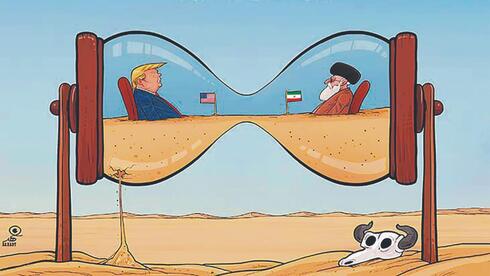
Three draft cease-fire and political-arrangement agreements for three Middle Eastern conflicts are now being advanced.
The most important draft concerns the confrontation with Iran.
Alongside it are a faltering cease-fire text for Lebanon and a long-term arrangement proposal for Gaza.
At this stage, none of the moves is certain, and in each arena there remains a possibility that fighting will resume or continue.
The talks on an agreement with Iran appear to be the most serious, and the emerging text is deeply troubling for Israel.
At its center, according to reports, is a U.S.
commitment to a complete halt of military action against Tehran and to lifting the maritime blockade, opening the Strait of Hormuz, a card the Iranians created during the war, and only afterward discussing Iran’s nuclear program.
Trump promised this week that Iran’s 60% enriched uranium would be taken out of the country and destroyed, but at least for now, Tehran has made no such commitment.
The other components that were supposed to be part of forcing Tehran to submit are absent from the reports, chief among them Iran’s long-range missiles and the Islamic regime’s regional proxies.
Also pushed to the sidelines is the Iranian people, whose protest movement was one of the “triggers” of the war and who were promised that “help is on the way,” alongside the collapse of the early-war fantasy that a fanatical regime could be brought down through “decapitation” and the use of minorities.
By contrast, the Islamic regime feels strengthened after surviving the greatest threat it has ever faced and is working vigorously to secure strategic gains.
Beyond guarantees meant to prevent another attack, Tehran is also demanding the lifting of sanctions, which would reduce domestic public and economic pressure, as well as the release of $24 billion frozen in banks around the world.
That was the purpose of this week’s visit to Qatar by Mohammad Bagher Ghalibaf, the speaker of parliament and currently the most powerful man in Tehran, Foreign Minister Abbas Araghchi and Iran’s central bank governor Abdolnaser Hemmati, a move that also illustrated Doha’s return to the forefront of mediation.
The growing confidence at the top of the Iranian leadership was reflected this week in the decision to restore internet access after it was cut during the wave of protests, and in the declaration by Mojtaba Khamenei, the supreme leader, that “the Middle East will no longer provide protection for American bases,” and that after the war the slogans “Death to America” and “Death to Israel” would spread throughout the Islamic nation, especially among young people.
In the background stands the Arab world, which contrary to reports, and to Israeli hopes, does not want Trump and Netanyahu to “go all the way.” It is instead seeking a rapid end to a confrontation it sees as doing more harm than good: the Islamic regime has survived and become more extreme, while the energy sector continues to suffer a severe crisis because of disrupted movement through the Strait of Hormuz.
The Arab hope now is that an agreement will create a rift between Israel and the United States and block what is seen as the consolidation of Israeli hegemony under Trump’s sponsorship.
“Any agreement between Tehran and Washington will be a personal defeat for Netanyahu, and will mark Israel’s return to the passenger seat after serving as the driver during the war,” the editorial in the daily Al-Quds Al-Arabi said this week.
To sweeten what appears to be a bitter pill for Israel, Trump promised this week that Saudi Arabia and Qatar would join the Abraham Accords, alongside a puzzling mention of Jordan and Egypt, which already have peace agreements with Israel, as well as Turkey and Pakistan.
The response was swift and predictable: Riyadh repeated its....