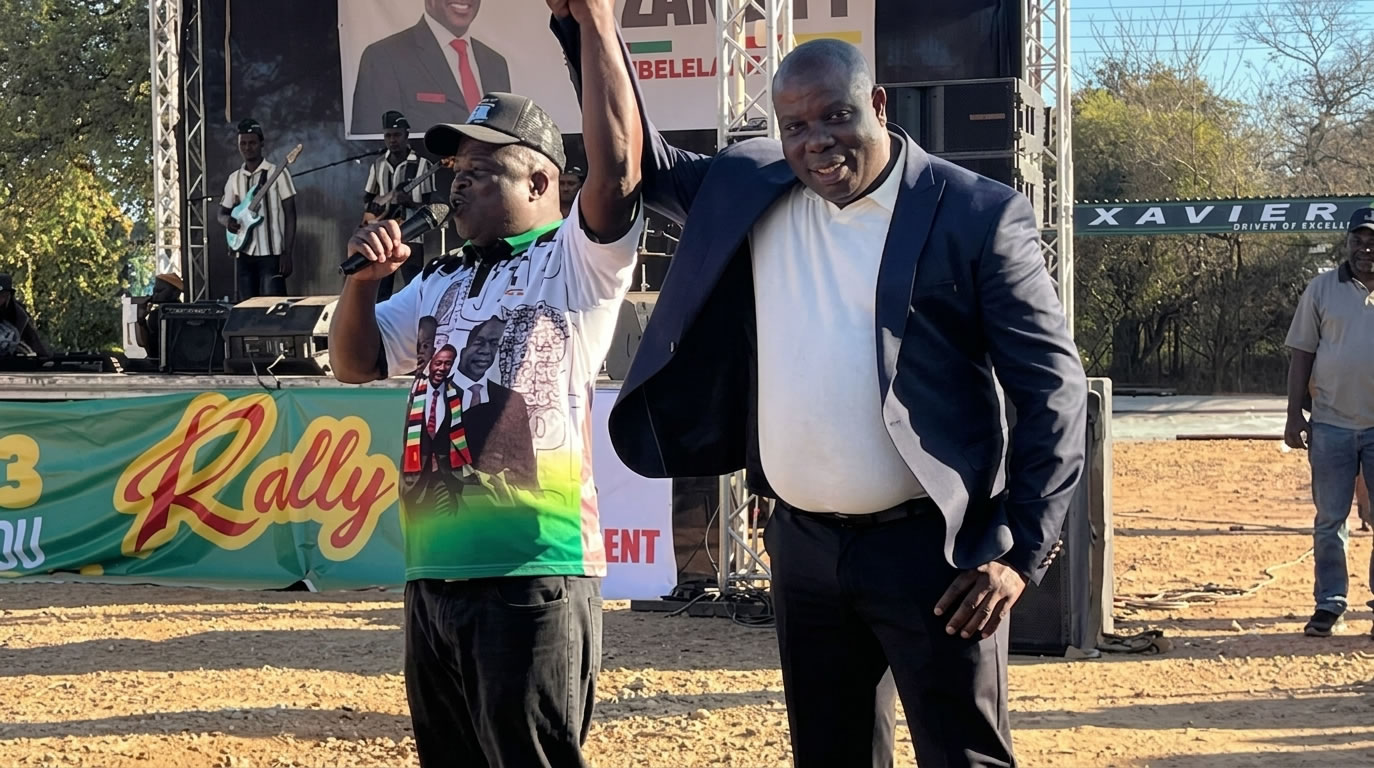
A Political Earthquake in Matabeleland The political landscape of Matabeleland has been irrevocably altered by the recent defection of Gift Banda, a former Bulawayo deputy mayor and a once-stalwart figure of the Citizens Coalition for Change (CCC), to the ruling Zanu PF.
His dramatic switch, announced at a high-profile rally in Gwanda, Matabeleland South, has ignited a firestorm of speculation and dismay across Zimbabwe.
While state media has predictably framed this as a “return to the fold,” investigative insights suggest a far more intricate and troubling narrative behind Banda’s sudden “conversion”.
For years, Banda embodied the spirit of opposition resilience in Bulawayo, navigating a labyrinth of legal challenges and internal party strife.
His unexpected alignment with Zanu PF, particularly as the ruling party pushes for a constitutional amendment to extend President Emmerson Mnangagwa’s term, has raised profound questions.
Is this a genuine change of heart, or a calculated manoeuvre for survival in Zimbabwe’s high-stakes political arena? The Man Behind the Headlines Gift Banda’s political journey has been anything but uneventful.
As a prominent figure within the CCC, he was a familiar face in Bulawayo, a city often considered an opposition stronghold.
His past was marked by a tenacious spirit, frequently clashing with authorities and defending his political ground.
This history makes his defection all the more perplexing for many who viewed him as an unshakeable pillar of the opposition.
His public declaration of support for Zanu PF and, crucially, for Constitutional Amendment Act No.
3 (CAA3), stands in stark contrast to his previous political allegiances.
At the Gwanda rally, Banda articulated his belief that joining Zanu PF and endorsing CAA3 would “help advance Zimbabwe’s political and economic development” and contribute to the nation’s goal of achieving upper middle-income status by 2030.
These statements, while seemingly forward-looking, are viewed with deep scepticism by many who recall his consistent opposition to the ruling party’s policies.
The Legal Noose: A Pattern of Pressure Investigative sources close to the matter suggest that Banda’s defection was not merely a spontaneous ideological shift but rather the culmination of sustained pressure, potentially involving a series of legal entanglements.
The ruling party has long been accused of employing a “catch and release” tactic, where opposition figures are subjected to legal and administrative scrutiny until they capitulate, only to be embraced as new allies once they switch sides.
Banda’s past is riddled with such legal controversies, painting a picture of a man frequently embroiled in battles with the justice system: • March 2017: Illegal Residential Stands Allegations Banda faced accusations of illegally acquiring residential stands in Bulawayo, leading to his temporary removal from office by the then Local Government Minister, Saviour Kasukuwere.
Banda vehemently denied these allegations at the time.
• February 2020: US$60,000 Land Transaction Fraud He was arrested on allegations related to a US$60,000 land transaction.
Prosecutors alleged that Banda and Bard Real Estate conspired to forge signatures to facilitate the sale of a residential stand in Selbourne Brooke, Bulawayo.
Both pleaded not guilty.
• December 2024: Forged O-Level Certificate Case Banda found himself in court again, accused of submitting a forged Ordinary Level certificate while seeking nomination for the Zimbabwe Football Association (ZIFA) vice-presidency.
The prosecution claimed that inquiries established the examination centre and candidate numbers on his submitted results slip belonged to another individual, Sino Gumbo.
These recurring legal battles, regardless of their outcomes, would undoubtedly have placed immense strain on....