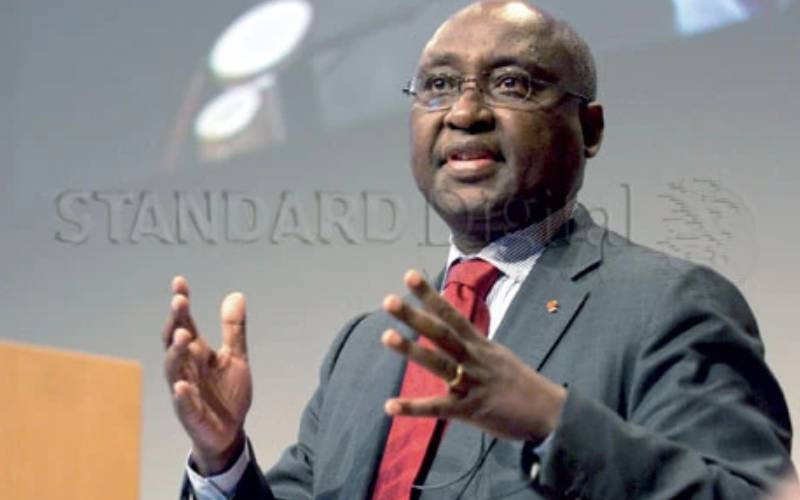
African Development Bank President, Donald Kaberuka.
[File, Standard] A richly endowed continent with as much population as China’s and India’s, but fragmented into 54 independent states, whose collective voice and feel are marginal in the evolving global order.
This is the sorry state of Africa, now reduced into a spectator as the hitherto Western hegemony crumbles, international norms and security collapse, geo-economic fragmentation and protectionism surges, technological competition rises and unstable multipolar system puts the world on the edge.
The new uncertainties brought about by the changes add to the swell of Africa’s pre-existing conditions: massive energy deficit, chronic food shortage, leadership and health crisis, insecurity, unemployment, climate vulnerability, and poor infrastructure.
In the last month, the world has stared at an energy crisis of unprecedented proportions following the closure of the Strait of Hormuz, the world’s most important oil transit route.
Africa sat on the edge, fidgety, waiting for the dark cloud to pass.
Yet Africa boasts of an incredibly massive energy potential of enormous oil and natural gas reserves, but also the highest solar potential globally, significant untapped hydropower, vast geothermal, wind and green hydrogen potential.
A rude awakening of sorts, the war in the Middle East has jolted key African institutions to begin to re-imagine the security and future of the continent, given the cutthroat competition shaping up for world resources and values.
“If you look at the pattern in the last few years, the crisis is the new normal.
Who would have imagined a war in the middle of Europe in the 21st century, who?” Donald Kaberuka, the 7th elected President of the African Development Bank, asked participants at the recently concluded Mashariki Cooperation Conference.
100 delegations The Conference is a Kenyan-led dialogue initiative to remodel Africa’s approach to security, emphasising intelligence-led strategies for peace and economic growth.
Over 100 delegations drawn from across the continent and beyond, including 37 director generals of African intelligence units, attended.
According to Kaberuka, the most important thing for the continent right now is to build critical buffers- political, social and economic resilience- to absorb and survive the shocks.
Africa must then re-establish its lost agency, look more inwards, grow its own financial autonomy, fund its own initiatives, and own development.
It must also, as a matter of urgency, revisit the stalled African Union reforms.
“Imagine the situation obtaining now with each of our 54 countries responding on their own, at their own pace, while India, with just as much population as ours, responds in a single voice?” Kaberuka wondered.
The journey to reform the AU began in 2016 under the chairmanship of Rwanda President Paul Kagame.
It aimed to make the Union more self-reliant, accountable and efficient.
The current chair of the reforms drive is President William Ruto.
At the Mashariki Conference, Ruto faced the intelligence chiefs in the eye and told them he was running into resistance.
He told them that a fit-for-purpose AU is a priority if Africa is to survive the geopolitical changes.
“I know many of you speak to African leaders, presidents in some very personal way, assist us to unlock the potential of our continent,” he pleaded with them.
At the cusp of 90 and ageing gracefully, former Nigerian President Olesegun Obasanjo is a man oozing in raw wisdom.
From the head of a military junta to the head of state, and from a political prisoner to a democratically elected president, and much later a statesman and peacemaker, he has seen it all.
Unlike many, he has nothing to hold back.
He told the conference that Africa, once again, is on the dinner table of Western states and their emerging Asian mates: “We are witnessing a new scramble for Africa.
China’s Belt and Road Initiative has deepened infrastructure links across Africa while also deepening dependency in a number of our member states.
Quoting research from Johns Hopkins University, he told the delegations that 49 out of the 54 African states had signed up to the initiative, turning China into Africa’s largest bilateral creditor.
On the other hand, Russia has expanded its presence in the continent through the Wagner Group and its successors in Mali, the Central African Republic, Libya and Sudan.
Russia has also recruited thousands of Africans to fight in Ukraine, including Kenyans, whose return, according to South Africa’s Deputy Director General of the State Security Agency Joyce Mashele, should worry everyone.
“Without proper rehabilitation, these fighters will easily become easy targets for recruitment,” she warned.
NIS estimates that close to 1,000 Kenyans are fighting in Russia, many having been tricked by trafficking syndicates into the war.
According to Obasanjo, in Libya since the fall of....