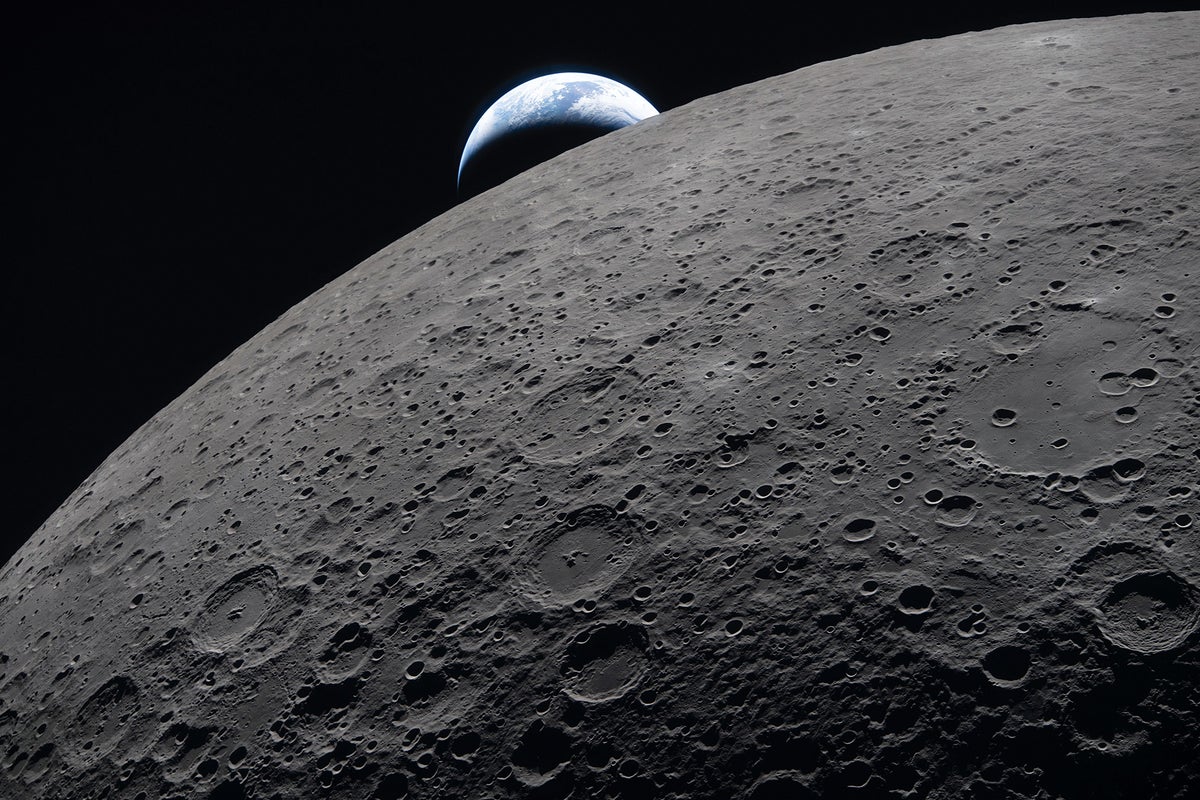
Astronomers are gearing up for a unique moon observation event: a stray piece of a SpaceX Falcon 9 rocket is on track to hit the lunar surface on August 5.
The collision and its aftermath, which may be visible from Earth and space-based telescopes, present an opportunity for some singular science.
In a new paper posted to the preprint server arXiv.org, 23 astronomers call on the scientific community to observe the event and note that it may be possible to record the impact as it happens.
The crash could reveal new information about what happens in the immediate aftermath of an impact on the lunar surface and offer insights into the hazards of errant space junk to the moon.
The meandering spacecraft was first spotted by amateur astronomer Bill Gray.
Launched in January 2025, the Falcon 9 ferried two landers to the moon—Firefly Aerospace’s Blue Ghost and Japanese firm ispace’s Hakuto-R.
After delivery, the rocket’s upper stage was meant to burn up on reentry in Earth’s atmosphere.
But as Scientific American reported in May, that didn’t happen.
On supporting science journalism If you're enjoying this article, consider supporting our award-winning journalism by subscribing.
By purchasing a subscription you are helping to ensure the future of impactful stories about the discoveries and ideas shaping our world today.
Instead it entered orbit around Earth at a similar distance as the moon.
Objects such as this are challenging to track from our planet, Gray noted in a recent blog post.
The rocket fragment’s motion is hard to predict, Gray wrote, because it is under the influence of both gravity and solar radiation pressure, a subtle force that effects its direction of travel in ways that are difficult to forecast.
Gray predicted that the 10,800-pound space....