Entanglement is the resource that quantum networks are supposed to run on, and it is also the thing most easily destroyed.
Engineers at the University of Pennsylvania have found something that outlasts it.
A pattern encoded in light held its shape after the entanglement carrying it had measurably vanished.
The pattern is called a skyrmion, and it is topological in the sense that mathematicians use the word.
Topology concerns properties that survive stretching and bending, the reason a doughnut and a coffee mug count as the same object.
The motivation is a practical bottleneck.
Linking quantum computers into larger systems needs optical interconnects, but quantum states degrade with the slightest loss of coherence, and the error correction that could fix this demands resources that limit how far it scales.
What persists in this case is a number.
The work appears in Nature Physics, from a team led by Liang Feng, a professor of materials science and engineering at Penn with a secondary appointment in electrical and systems engineering.
"It's as if one dancer's unique movement suddenly became part of a duet, and persisted even when the dancers were separated," Feng said of the transfer.
He added that encoding information in such resilient patterns could lay the groundwork for more reliable quantum networks.
An optical skyrmion is not a shape you could photograph.
It lives in how the light's polarization, the direction its waves oscillate, varies from point to point across the beam.
"The light oscillates in different directions depending on where you inspect it," said Haoqi Zhao, the paper's first author, now a postdoctoral fellow at Yale and formerly a member of Feng's lab.
He compared it to the way patches of hair on a head grow in different directions.
Across the beam those variations sweep through every possible polarization state a whole number of times.
That integer is the skyrmion number, and it is what topology protects.
Zhao offered a second comparison for why.
Think of a swirl in someone's hair, he said, where individual strands can be pushed out of place without changing the overall pattern.
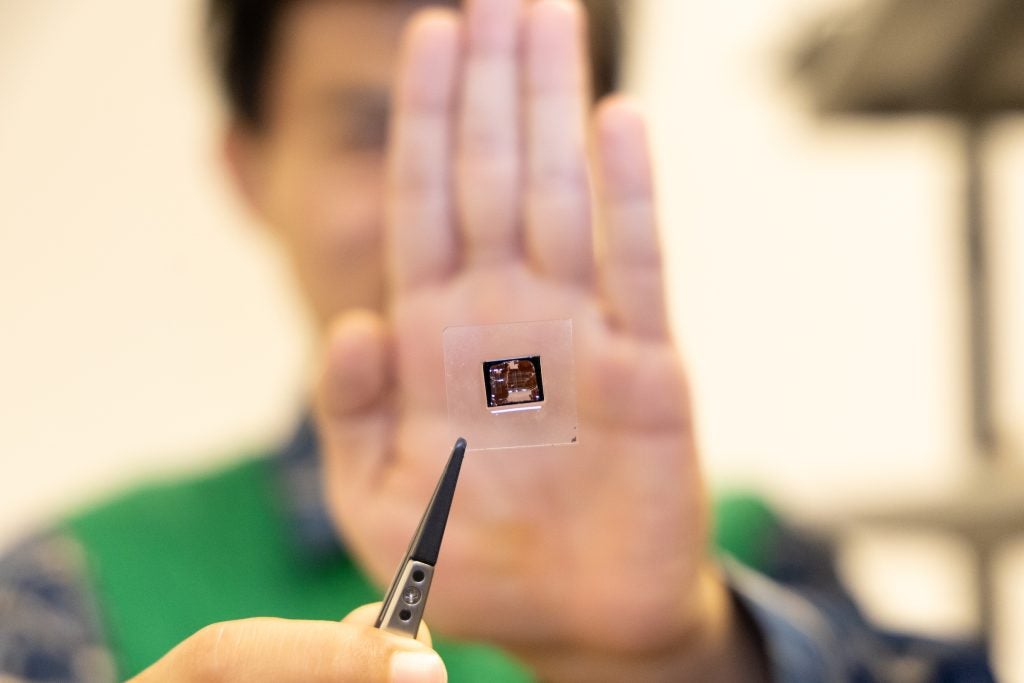
The device is a photonic circuit built on a silicon nitride layer 310 nanometres thick, fabricated at Penn's Singh Center for Nanotechnology.
A femtosecond laser pulse pumps two spiral waveguides, which occasionally convert pump light into a pair of photons through a process called spontaneous four-wave mixing.
From there the two photons take different routes.
Tunable interferometer arrays steer one photon toward microring resonators that encode the skyrmion, and send the other to a grating coupler that converts its path into a polarization.
The resonators do the distinctive work.
Each ring carries gratings etched along both its inner and outer walls, which emit light with opposite handedness and different amounts of orbital twist, and the superposition of those two outputs forms the skyrmion.
Transferring the pattern then requires a measurement rather than a transmission.
The team performs a joint measurement on the first photon that projects it onto one of four possible correlated states, which heralds a matching skyrmion now shared between both photons.
"It's a bit like building an entire factory in miniature," said Yichi Zhang, a doctoral student in materials science and engineering and a co-author.
One section makes the entangled photons, another routes them, and a third creates the pattern, he said, with the difficulty lying in getting the parts to work together.
Reconstructing these states takes tomography, a procedure that rebuilds a quantum state from many repeated measurements.