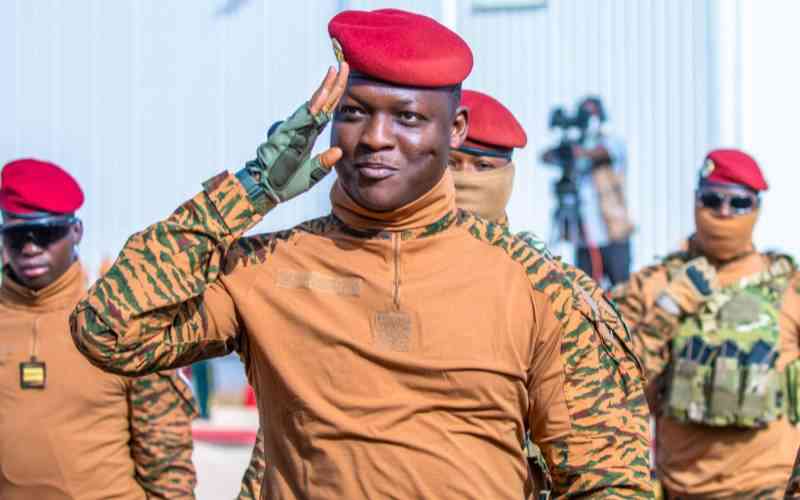
Captain Ibrahim Traoré of Burkina Faso.
[File Courtesy] Burkina Faso’s Traoré right on economy, wrong on democracy Since coming to power in a military coup three years ago, Capt Ibrahim Traoré of Burkina Faso, in West Africa, has fast risen in the admiration stakes, particularly among those around the continent tired of political meddling by former colonial powers—France, Britain, Germany, Belgium, Italy and Portugal—plus the United States.
Of all the military men who have taken power lately in the region’s “coup belt” countries—including Mali, Guinea, Niger and Gabon—Burkina Faso’s Traoré, 38, is by far the most agreeable pin-up of the revolutionary zeitgeist in Africa of the last four decades.
When I was a babbling eight-month-old in October of 1987, Thomas Sankara (also of Burkina Faso) was assassinated.
Sankara — who’s since been called ‘the Che Guevara of Africa’ —during his four-year-long hold onto power beginning in 1983, famously embraced austerity (riding a bicycle to work) and, just like Traoré, favoured an African-solutions-to-African- problems approach to development.
Part of the reason why Traoré is ‘different’ and popular, for instance, is his insistence on committing foreign-owned firms operating in his country —particularly those involved in the extraction and export of natural resources—to a greater, mandatorily transferable, for-the-people share of profits.
His policy of Africanising resource extraction by introducing, and/or increasing, State shareholding in foreign-owned firms in Burkina Faso is more widely being paraded as the standard model for the rapid, resource-fuelled transformation of Africa.
His uncompromising mien is the making of his support base of Africanist believers in a hero-amplified, sterner ‘Afrosay’.
And the legend of his courage, vision, exploits, novelty and stardust (especially if he keeps up the streak of toughness and manages to avoid the peculiarly African ‘curse of incumbency’) will, no doubt, live on long after he departs from this world.
Gaddafi’s model Some very important aspects of the Traoré-evolved transformation pitch are, however, potentially inimical to the hoped-for goal that’s Africa’s collective, own-agency progress.
Earlier this year, the Traoré (military) regime declared a ban on all political parties in the country.
And in the past three weeks, he has been at it again, this time making a case for an African-wide de-embrace of democracy.
His thesis is that democracy is not originally....