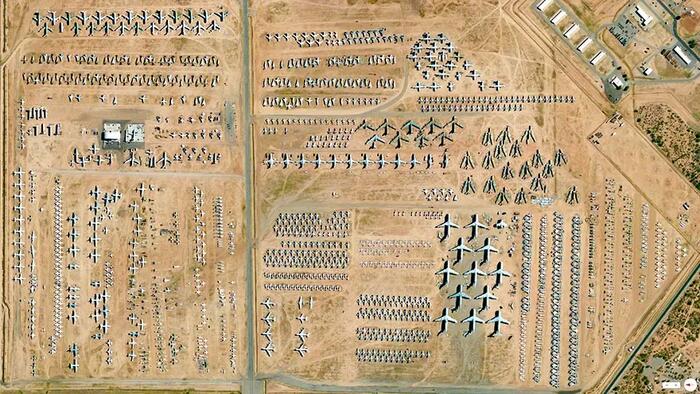
They are the dinosaurs of the modern age—hulking retired aircraft baking in the Arizona sun, stretching in rows across the desert.
Once America’s defenders of the sky—B-52 Stratofortress and B-1B Lancer bombers, F-16 Fighting Falcon fighters, C-130 Hercules and C-5 Galaxy cargo planes—they now sit idle, preserved for parts or history.
Maintaining and reclaiming these aircraft is no small task at the nation’s only military aircraft “boneyard.” At Davis–Monthan Air Force Base, the 309th Aerospace Maintenance and Regeneration Group (AMARG) oversees that work.
public relations manager Robert Raine said during an April 21 tour of the 2,600-acre (4-square-mile) AMARG facility in Tucson.
Each aircraft is secured for long-term storage, drained of fluids, stripped of explosive components, and preserved against the slow wear of the desert.
Depending on the aircraft, some could be brought back into service, Raine said.
Since 1964, the maintenance group has served as the sole designated storage, salvage, and disposal center for U.S.
military and government organization aircraft.
(Top) A row of military helicopters in storage at the 309th Aerospace Maintenance and Regeneration Group in Tucson, Ariz., on April 21, 2026.
(Bottom) A C-5 Galaxy cargo plane with a 223-foot wingspan overshadows other military aircraft in storage at the “Boneyard” at Davis-Monthan Air Force Base in Tucson, Ariz., on April 21, 2026.
Allan Stein/The Epoch Times The facility employs more than 700 workers and encompasses more than half a million square feet of industrial space.
Here, aircraft come to die, hibernate, or be reborn, their components cleaned, repaired, and repurposed for use in other machines—for conflicts now and those yet to come.
The facility opened shortly after World War II, on April 1, 1946.
The site was chosen for its dry desert climate and its ability to store vast quantities of surplus aircraft and military equipment.
Hard caliche soil, along with the absence of earthquakes and extreme weather such as tornadoes and hurricanes, made it an ideal place for long-term storage.
USGS orthophoto of Davis-Monthan Air Force Base in Tucson, Ariz., on May 16, 1992.
United States Geological Survey/Public Domain, CC0 The sprawling boneyard is home to 3,488 aircraft, ranging from supersonic fighter jets to massive refueling and cargo planes to strategic bombers—75 aircraft types and 6,700 engines in all.
“AMARG is the last stop for parts” for legacy aircraft, Raine told The Epoch Times.
However, it is “not an infinite source.” When a component is needed, the request typically begins in the global supply system, he said.
If it is not available there, the request moves up the chain to Air Force weapon system program offices, Navy and Marine Corps program management authorities, or Navy Supply Weapon Systems Support.
The 309th Aerospace Maintenance and Regeneration Group at Davis-Monthan Air Force Base in Tucson, Ariz.
Since 1964, the maintenance group has served as the sole designated storage, salvage, and disposal center for U.S.
military and government organization aircraft.
Overviews created with Apple Maps, satellite imagery courtesy of Digital Globe Those agencies can then draw from the maintenance group’s vast inventory.
In that system, the boneyard functions as a deep reserve—an industrial fallback where retired aircraft continue to serve, one part at a time.
Raine noted that AMARG does not own any of the aircraft or other assets stored at the facility.
Ownership remains with the original service branches or organizations that delivered them, including U.S.
government agencies such as the Coast Guard and Forest Service, allied governments, and private institutions such as the Smithsonian Institution.
The group has roughly 80 customers.
But when it comes to procuring and delivering parts, its crews often work on short notice and tight timelines.
A B-1 bomber at the 309th Aerospace Maintenance and Regeneration Group “boneyard” in Tucson, Ariz., on April 21, 2026.
Each aircraft at the boneyard is secured for long-term storage, drained of fluids, stripped of explosive components, and preserved against the slow wear of the desert.
Allan Stein/The Epoch Times Each year, AMARG receives an average of 250 to 300 aircraft.
Its five core missions are storage, reclamation, regeneration, modification, depot-level maintenance, and disposal.
The planes are inventoried, flushed of fluids, washed, sealed tightly with tape and a special spray material, and stored for years or decades.
“They’ve taken off hazardous materials.
They’ve taken off anything that might be classified.
They’ve taken off anything that might need to be broken down to demilitarization,” Raine said.
“They’ve drained it to make sure that any residual preservative oil is out of it.
They’ve drained the hydraulics out of the landing gear.
They’ve depressurized any systems in the aircraft.
(Left, Right) Workers at the 309th Aerospace Maintenance and Regeneration Group remove the pilot ejection system at Davis-Monthan Air Force Base in Tucson, Ariz., on April 21, 2026.
The facility employs more than 700 workers and encompasses more than half a million square feet of industrial space.
Allan Stein/The Epoch Times The most recent aircraft to arrive was an F/A-18E Hornet in mid-April.
The longest-stored aircraft is a Navy T-1A Sea Star, which arrived on April 6, 1970.
Among the rarest are the XC-99 heavy cargo aircraft, a YC-14 military transport aircraft, and a T-46 light jet trainer aircraft.
The F-16 Fighting Falcon is the boneyard’s most numerous resident, with more than 350 aircraft.
Some have been dismantled and sent to Ukraine for use as training platforms.
It is followed by more than 315 C-130 Hercules aircraft, nearly 300 F-15 Eagle fighters, and 235 A-10 Thunderbolt II aircraft.
The second YC-14, one of only two ever built, is stored at Davis-Monthan Air Force Base in Tucson, Ariz., on Jan.
The aircraft is among the rarest at the boneyard.
(w:en:Kitplane01 (talk | contribs), CC-BY-3.0) In April, the Air Force moved a retired KC-135 Stratotanker out of long-term storage at the base for possible reactivation following losses of aerial refueling aircraft in the Iran conflict, according to FlightGlobal.
In 1948, “when the Soviet Union closed road, rail, and canal traffic into Berlin ...
about a quarter of the stored C-47 Skytrain cargo aircraft were withdrawn from storage and returned to flying service in support of the Berlin Airlift,” according to the Department....
/socialsamosa/media/media_files/2026/05/12/fi-7-2026-05-12-23-44-45.png)