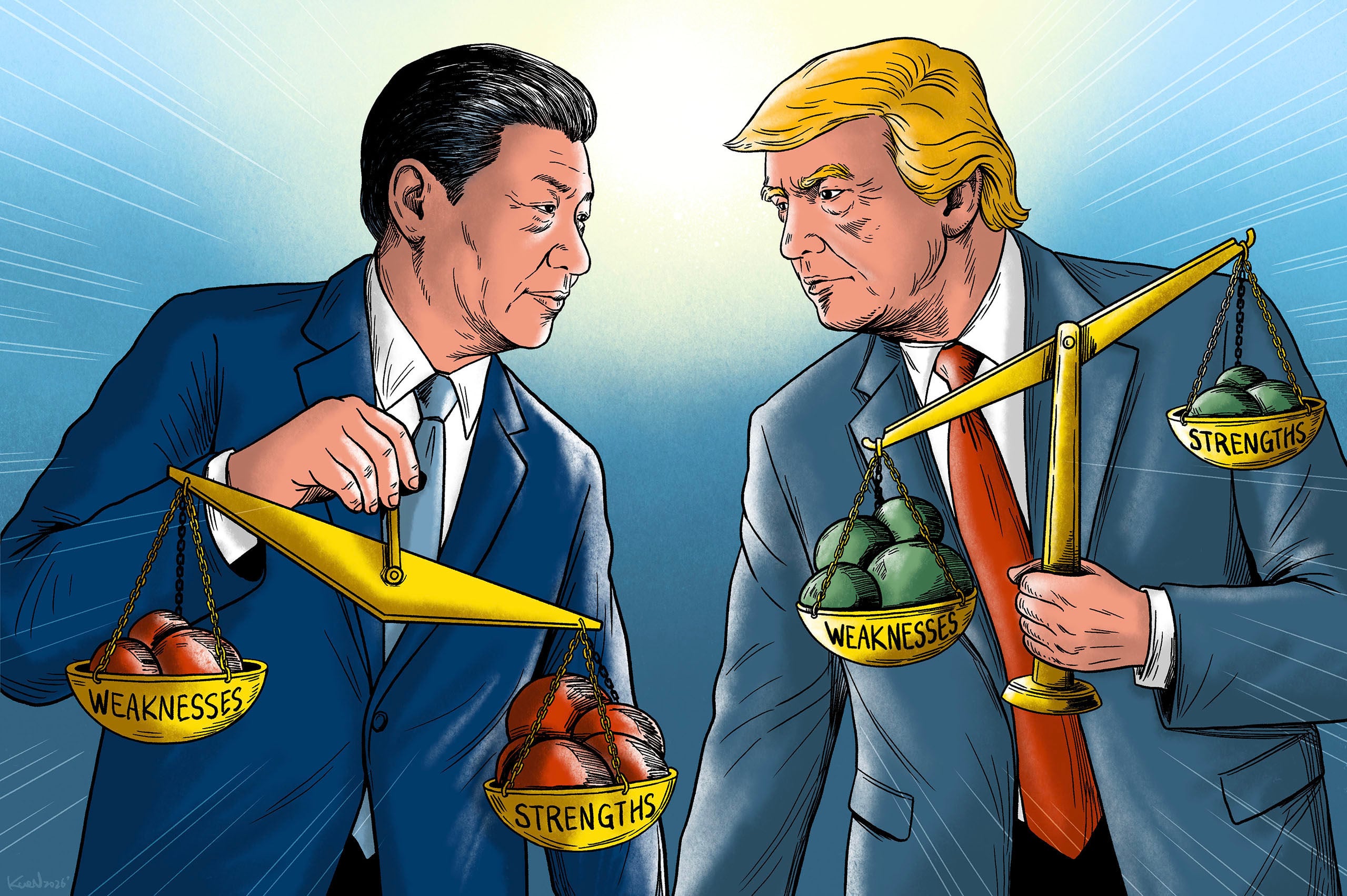
US President Donald Trump’s landmark visit to China comes as the Iran war disrupts global energy supplies, fuels economic uncertainty and adds fresh strain to Washington-Beijing ties.
In the latest part of a series examining how rivalry, interdependence and geopolitical crises are reshaping the relationship between the two powers, we look at how Trump’s weakened hand could tilt summit talks.
When next week’s summit between US President Donald Trump and Chinese President Xi Jinping was first proposed, Trump was riding relatively high and Xi was holding steady against his impetuous counterpart.
Six months later, Trump heads to Beijing politically dented and militarily overextended, factors that diplomacy experts, China analysts and former government officials say will shape the meeting’s tenor.
While summits are mostly about foreign policy, protocol and deliverables, dynamics back home underpin the negotiations.
“There’s no question that weakness on the domestic front puts a president in a precarious position on the global stage, especially when dealing with a leader like Xi Jinping.
He not only senses that weakness but works to exploit it,” said former White House global engagement director Brett Bruen.
“China has been trying to position itself as the more reasonable actor among global superpowers.
So this is a prime moment for him to both try and manipulate and outmanoeuvre the other.” Traditionally, potential weak points are outlined in exhaustive briefing materials before high-stakes meetings.
Trump is not traditional and tends to favour his “gut”, although power dynamics are hardly lost on him, even if he does not acknowledge them.
Behind closed doors, these could play out as reduced Chinese offers for soybeans or Boeing aircraft purchases and a stronger push for concessions on tariffs, Taiwan, export controls and the Iran conflict.
“You offer a series of demands, which the Chinese know that Trump is going to be desperate to hold up as a prize,” added Bruen, president of risk consultancy firm Global Situation Room.
“This is something that Xi can dangle in front of Trump, albeit in terms not as advantageous as they would have been a year ago.” A different economic landscape The most obvious change since last October’s Trump-Xi summit is the war that Trump and the Israelis started against Iran; back then, the iconoclastic US president’s hunger for disruption was largely limited to trade.
Briefing reporters on the way back from South Korea last autumn, he said his muscular tariffs war had secured a year-long trade truce with Beijing and his global import tax policies were filling US coffers.
Foreign companies would pay the tax, he insisted repeatedly.
Since then, Trump’s muscle flexing has morphed into actual war, deepening the alienation felt among US allies, further roiling markets and turning the quick conflict he envisioned into a slog.
“China’s negotiating position is stronger than it was in the fall on a number of fronts,” said Allen Carlson, associate professor at Cornell University.
“Obviously and most prominently, we’re now in an extended conflict that doesn’t have an obvious endgame.” Furthermore, the US Supreme Court ruled his signature tariff policy unconstitutional and denied his bid to delay or deny some US$166 billion in refunds.
That has left him scrambling for a workaround requiring mandatory investigations, paper trails and an appeal process, curtailing his ability to set policy by tweet, even as a trade court on Thursday struck down a 10 per cent tariff stopgap he had imposed globally.
“The US still has substantial leverage,” said Felicia Pullam, a former Commerce Department trade expert now with Apco consultancy.
“But the perception of leverage has taken a hit.” Apparently unanticipated, Trump’s foreign military adventures have ricocheted back onto his “America first” domestic agenda, as higher gas prices and an unpopular war sour US voters ahead of the November midterm polls, leaving him weaker flying into Beijing.
“The Xi-Trump summit, if it finally is to materialise, will likely see a seemingly stronger Xi and surely much weakened Trump.
This is largely because Trump has the sword of Damocles of the forthcoming midterm hanging over his head,” said Chen Jian, global history professor with New York University and NYU-Shanghai.
“As a political gambler, he has fewer cards in his hands than ever before.
He needs Xi more than Xi may need him.” Despite the war, Trump appears to welcome the summit as a way to counter the bad news, showcase himself on a big stage and grab some much-needed deliverables – such as they are – to show progress with disenchanted voters, analysts said.
This is not lost on China.
“They didn’t ask for the summit,” said Rana Mitter, US-Asia relations chair at the Harvard Kennedy School.
“They feel they will have the advantage with the Americans coming to them.” Trump’s US approval rating since October has fallen by over 10 percentage points to around 62 per cent, his lowest ever, with the economy, immigration and foreign policy flagging.
China does not....