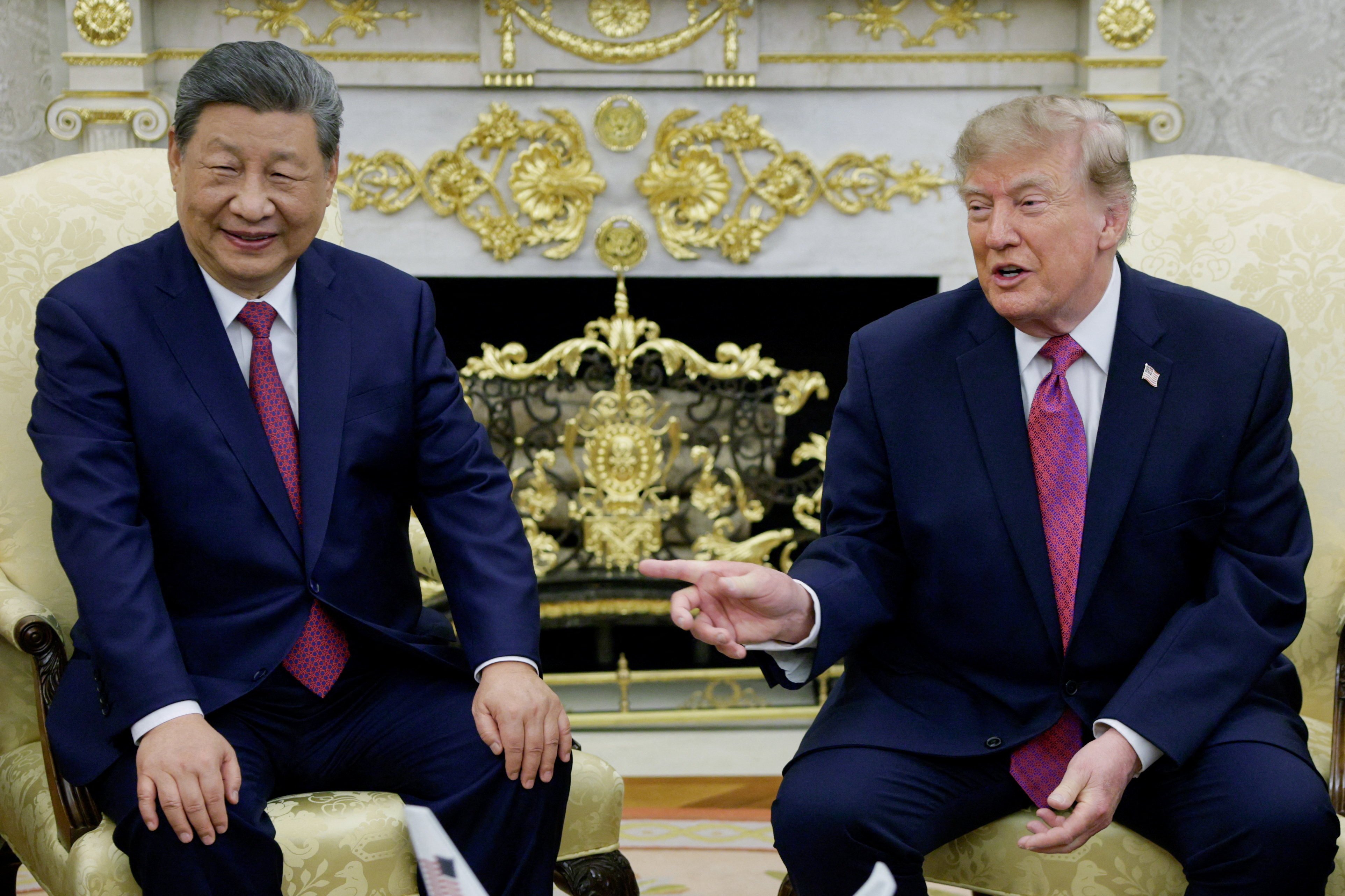
Donald Trump asked President Xi Jinping whether Beijing wanted to buy American weapons, the US ambassador to China said on Sunday, prompting the State Department to quickly rule out any such deal with Washington’s principal strategic competitor.
“He actually asked President Xi, would he like to buy some at one point,” the ambassador David Perdue said on Fox News after Xi’s state visit to the White House last week.
He did not say when Trump raised the question, what prompted it, or how the Chinese leader responded.
A State Department official, speaking on background to the South China Morning Post, said: “US law prohibits arms sales to China and there is no offer or plan to sell arms to China.” The swift clarification came as the disclosure ricocheted among Asia specialists, who noted the extraordinary contrast between Trump reportedly raising the prospect of arming Beijing and his administration continuing to hold up a roughly US$14 billion weapons package for Taiwan.
Washington has spent decades treating Beijing as a strategic rival, restricting military technology exports, strengthening security partnerships across the Indo-Pacific region and building its capacity to deter a potential conflict.
That is what makes Trump’s reported offer so extraordinary: the US has not sold conventional weapons to Beijing for more than three decades and has spent much of that time building its military posture around deterring the Chinese military, not supplying it.
In the 1980s, the Reagan administration briefly expanded military cooperation with Beijing as both countries sought to counter the Soviet Union.
Washington approved several military related sales, including the roughly $550 million Peace Pearl programme involving US avionics for Chinese J-8 fighter aircraft.
That relationship ended after the Tiananmen Square crackdown in June 1989.
Then-president George H.W.
Bush suspended military sales and exchanges with Beijing.
Congress later codified restrictions on the transfer of US defence articles to the Chinese military.
US law permits a presidential waiver in the national interest, but no administration has used that authority to restore a conventional US arms pipeline to Beijing.
The strategic landscape has since changed dramatically.
Successive US administrations have spent billions preparing for a possible military confrontation with Beijing and supplying weapons to Taiwan to help deter a potential attack.
Meanwhile, China has built the world’s largest navy by number of ships and rapidly expanded its missile, air and nuclear capabilities.
The Pentagon has identified Beijing as the United States’ most consequential long term strategic challenge.
That makes Perdue’s disclosure particularly striking.
Zack Cooper, an Asia security fellow at the American Enterprise Institute and former Pentagon and White House official, wrote on social media that he was “underwhelmed when it looked like the big deliverable both sides actually announced at this Trump-Xi summit was the lease of two pandas”.
“But it never occurred to me that an American president might offer to sell American weapons to China, he added.
Cooper later stressed that the remark came directly from Perdue, not an anonymous source.
“This wasn’t a leak, it was a comment by President Trump’s ambassador to China on Fox,” he....


