In the past, the last day of state visits to China has typically featured a deal-signing ceremony presided over by leaders from both sides.
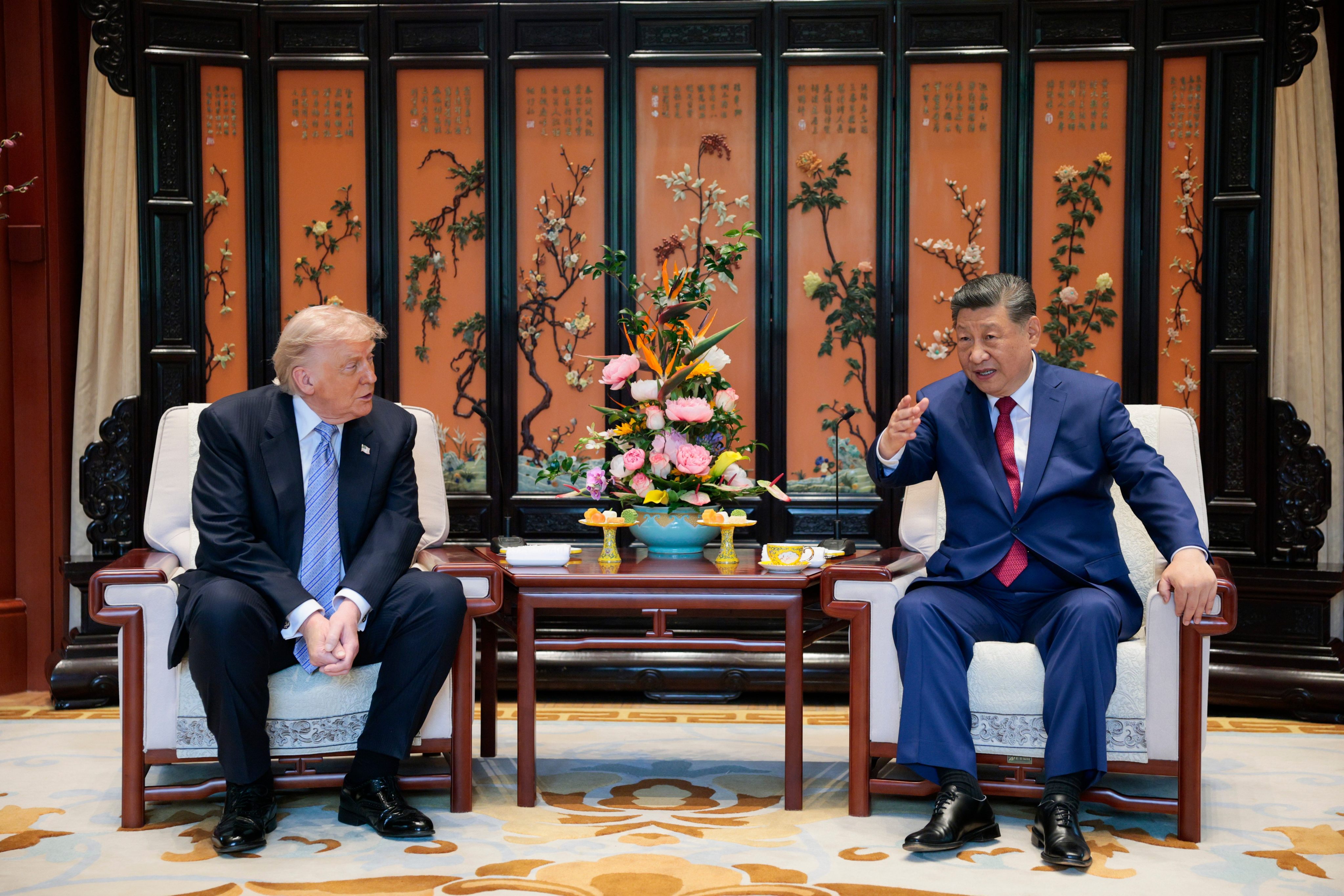
However, the last day of US President Donald Trump’s visit to Beijing was marked by discussions with Chinese President Xi Jinping in a more intimate setting and an assurance that both would continue to meet this year.
The two men strolled the gardens of the secluded Zhongnanhai compound, where Communist Party leaders live and work, a rare backdrop for diplomatic activities.
During a photo call after the walk, Xi described Trump’s visit as “historical” and “a landmark”, adding that “important consensus was made on issues both sides are interested in”, according to the Chinese summary.
Trump described his whirlwind state visit to Beijing as “fantastic” and once again praised Xi, calling him an old friend of over 11 years and highlighting how their personal connection had made it possible for them to resolve many thorny issues.
Trump and Xi will have the chance to renew that relationship later this year, with Chinese Foreign Minister Wang Yi confirming that Xi will pay a state visit to the United States in the autumn.
“Both sides should work together to make thorough preparations, create a favourable atmosphere, and achieve more substantive outcomes for the interactions and exchanges between the two heads of state,” Wang said.
Wang also stressed the importance of policy continuity, “particularly in honouring the commitments made”.
“By consistently moving towards each other, China and the US can inject greater certainty to our development and the world through the positive expectations generated by China-US cooperation,” he said.
Xi’s focus for the trip has been on putting guardrails on bilateral relations through the framework of “constructive strategic stability”.
In the grounds of Zhongnanhai, Xi once again reassured Trump that his vision to “Make America Great Again” could coexist with “China’s great rejuvenation” – an idea that the Chinese president initially raised during the state banquet the previous evening.
However, the Chinese side was muted on Trump’s suggestion that many commercial deals had been made, offering only vague indications and references.
Since the summit in the Great Hall of the People on Thursday, Trump has told the media several times that China has agreed to buy 200 Boeing planes and a range of agricultural products.
He also said that Beijing was interested in buying US oil to reduce reliance on the Strait of Hormuz.
The market is eagerly waiting for details of those deals.
It is also closely watching the activities of the CEOs in Trump’s delegation, which included some of the wealthiest and most powerful tech titans, such as Tesla’s Elon Musk, Apple’s Tim Cook and Nvidia’s Jensen Huang.
On Friday night, Wang said the two leaders discussed trade and economic relations in depth, and the two sides were still consulting on details regarding agricultural market access and expanding trade within a framework of reciprocal tariff reductions.
“They aim to finalise the outcomes as soon as possible and work together to ensure their effective implementation,” state news agency Xinhua quoted the foreign minister as saying.
On the flight back home on Air Force One, Trump said the issue of Nvidia’s H200 chips came up in the summit, but that China wanted to “develop their own”.
“But it did come up and I think something could happen on that.” The chips are designed specifically for generative AI, large language models and high-performance computing.
They are among the world’s most advanced and sought-after semiconductors.
The summit was also closely watched for any word on Taiwan, a potential flashpoint....