News Americas, WASHINGTON, D.C., Sun.
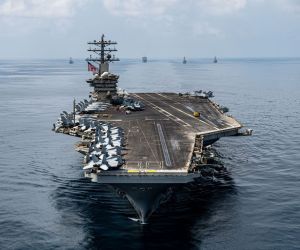
May 30, 2026: On Monday June 1st, the USS Nimitz – one of the largest and most powerful naval vessels on the planet – will drop anchor at the Port of Kingston, Jamaica.
Ninety miles away, Cuba is watching.
The nuclear-powered aircraft carrier’s arrival in Kingston Harbor marks the final stop of Southern Seas 2026 – an 11th iteration multinational goodwill deployment announced by US Naval Forces Southern Command that has taken the carrier throughout South America and the Caribbean.
The United States Embassy in Jamaica has framed the June 1 to June 5 visit as an exercise in maritime cooperation and people-to-people connections.
But the timing, the context, and the fractures it has exposed within the Caribbean Community tell a far more complicated story.
The USS Nimitz is not a goodwill vessel in the conventional sense.
It is a Nimitz-class nuclear-powered supercarrier – one of the largest warships ever built, capable of carrying dozens of combat aircraft and projecting overwhelming military force across an entire ocean.
Its arrival in Kingston comes at a moment of extraordinary tension between the United States and Cuba – the most dangerous escalation in US-Cuba relations since the Cuban Missile Crisis of 1962, according to analysts tracking the situation.
In the weeks leading up to the Jamaica port call, the Trump administration unsealed a superseding federal indictment charging former Cuban President Raul Castro with the alleged murders of four Americans in the 1996 shoot-down of unarmed civilian aircraft.
Secretary of State Marco Rubio publicly described Cuba as “a failed state 90 miles from our shores run by friends of our adversaries” — while standing at Homestead Air Reserve Base in Florida, approximately 180 miles from Havana.
The administration expanded secondary sanctions targeting foreign entities doing business with Cuba.
And US Southern Command confirmed the Nimitz carrier strike group’s deployment to the southern Caribbean.
The carrier is now coming to Jamaica, and Cuba, which sits between Florida and Kingston, is watching every move.
The United States Embassy in Jamaica was careful in its framing of the visit.
Chargé d’Affaires Scott Renner described it as underscoring “the depth of the US-Jamaica bilateral relationship and the importance the United States places on its enduring partnership with Jamaica.” “The visit of a US aircraft carrier to Jamaica marks an important milestone in the longstanding partnership between our countries,” Renner said, as quoted in the Embassy announcement.
“Beyond strengthening maritime cooperation and regional security, this visit creates opportunities for meaningful people-to-people connections and economic benefits for local communities.” The language is deliberate.
Carefully calibrated to frame a nuclear-powered supercarrier docking in the Caribbean’s third-largest island as a routine partnership exercise.
Whether Jamaica – and the broader Caribbean – accepts that framing without question is another matter entirely.
As questions swirled about the timing and implications of the USS Nimitz’s arrival, Jamaica House – the Office of the Prime Minister -moved swiftly on May 29th to frame the visit in decidedly civilian terms.
In an official press release, the government noted that the Nimitz had previously visited Panama, Chile, Argentina, and Brazil as part of its Southern Seas regional tour – and had hosted government officials from Guyana and Suriname while in South America.
The statement emphasized people-to-people activities during the Jamaica visit – including the beautification of four schools in collaboration with the Jamaica Defence Force, youth sporting activities on June 4, and opportunities for Jamaican students to be exposed to world-class maritime operations and infrastructure.
“Jamaica and the United States have long shared common interests in regional stability, maritime cooperation, disaster response, trade, education, and security,” the statement read, as quoted in the Jamaica House press release.
“The visit of the USS Nimitz provides a further opportunity to reaffirm these bonds and to strengthen mutual understanding between both nations.” The carefully calibrated statement made no mention of Cuba, the escalating US-Cuba crisis, or the broader geopolitical context in which the carrier’s Caribbean deployment has taken place.
The arrival....