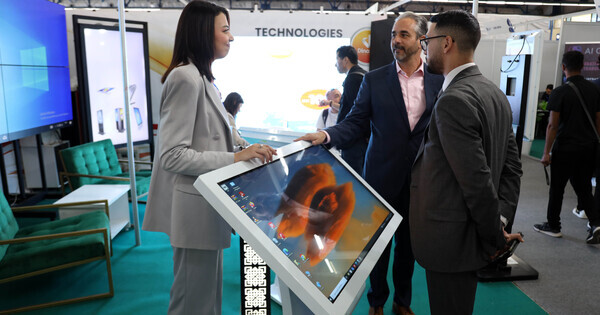
China’s largest trade show is now under way in the southern city of Guangzhou.
The Canton Fair is a colossal month-long affair with around 32,000 exhibitors and is often described as a shop window for Chinese manufacturers – a barometer of the China trade – where just about anything and everything can be bought.
This year the mood is subdued.
“The specter of the Iran war hung heavy like the banners inside the gigantic exhibition halls,” as Bloomberg described it.
Exhibitors reportedly complained of soaring costs and falling orders, most notably from the Middle East.
China’s economy is highly dependent on exports, and the show’s opening coincided with President Xi Jinping’s first public remarks about the war, complaining to visiting Spanish Prime Minister Pedro Sánchez that the international order is “crumbling into disarray.” Yet Xi has been preparing for a moment like this ever since he came to power in 2012.
In many ways China is in a better position than most to weather the storm – at least in the short term.
The country is estimated to hold the world’s largest reserves of oil – around 1.3 billion barrels, roughly equivalent to three months of imports – prompting Treasury Secretary Scott Bessent last week to accuse China of hoarding oil supplies.
At the same time it is investing heavily to extract oil from what remains of its own fields, as well as in fracking and nuclear capacity.
It continues to dig coal and build coal-fired power stations at a faster rate than the rest of the world combined.
China is also a world leader in the installation of renewables such as wind and solar.
This is mistakenly described by more starry-eyed Western environmentalists as a “green” policy.
Beijing has never had any desire to be a good global citizen.
It is a hard-nosed industrial policy, part of a bid for energy security, designed to insulate China from the sort of shocks the world is now experiencing.
“Fortress China,” as it has been dubbed, is also part of a wider economic plan for self-sufficiency: to make China less reliant on the world while making the world more dependent on China.
“De-risking” or “de-coupling” as a policy was alive and well in Beijing well before it became fashionable in the West.
And as the world inevitably seeks to lessen its reliance on hydrocarbons in the wake of the Iran war, China is calculating that it is in an ideal position to utilize its vast overcapacity in renewable technologies and dump its heavily subsidized surplus on global markets – thereby deepening dependence on China for key technologies of the future.
All that said, the fortress is not entirely impregnable.
China remains the world’s largest energy importer, buying roughly 70 percent of its oil and 40 percent of its gas from abroad.
A little over....