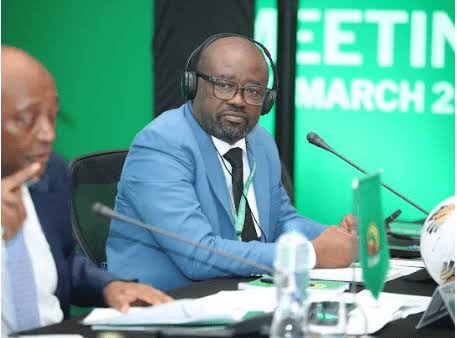
There are two versions of Kurt Edwin Simeon-Okraku, president of the Ghana Football Association (GFA).
One is emotional, sometimes loud, and even theatrical.
Those closer to him and have known him for many years say, he's a passionate man, and that sometimes he allows the passion to get the better of him.
They may be right.
If not, why would he walk to the dining room of the Black Stars, under the weight of failure and anger, spend 17 minutes rebuking the boys for drawing against Niger during a 2025 African Cup of Nations (AFCON) qualifier? Why would he take a microphone before global cameras and tell the world that a coach he hired to manage Ghana's senior national team was a trial and error technical brain.
The other is quieter.
When you listen to him, strategy is a word he uses often, and that word is the second version of him.
A version that's less visible, less discussed by stakeholders and the media.
Because while the senior national team, an embodiment of this country has stumbled through one of its most turbulent eras, failing miserably at every major tournament since he took over the reigns of Ghana football in October 2019, there appears to be deliberate pivot beneath the surface: Ghana has become a recurring host of youth football competitions.
And that may not be accidental.
GFA, under the 54-year-old, has consistently positioned Ghana as a destination for youth tournaments across the West African and continental space.
Consider the pattern: WAFU Zone B U-17 Championship ( Cape Coast, June 2022) WAFU B U-20 Girls Championship (Kumasi, June 2023) WAFU Zone B U-17 Championship (Legon, May 2024) WAFU B Girls Championship (Ghanaman Soccer Centre of Excellence, December 2024) CAF African Schools Football Championship (Legon, April 2025) CAF U-20 Africa Cup of Nations (2027 – scheduled) This is not a coincidence.
It appears to be a policy.
A policy to make Ghana a destination for youth football and, in the long-term, continental or even football.
That very Monday, April 27, 2026, dawn, when Mr Okraku posted on his Facebook page, "2027 U-20 Boys AFCON to be Hosted by Ghana." I began to take a closer look at the trend.
Ghana has hosted five youth tournaments in the last four years and will host the U-20 African Youth Championships for the first time in 27 years.
It is a trend that appears to be deliberate.
Hosting youth tournaments is often dismissed as low-stakes football administration.
People hardly show up to watch unless you're a scout, then there's limited attention from the media, and sometimes modest or zero commercial returns.
But in truth, it is one of the strategic plays in football development.
You bid for youth tournaments not because they are glamorous but because they demand standards.
Standards in infrastructure.
Standards in logistics.
Standards in administration.
And each successful hosting becomes both a test and a justification for investment.
CAF does not hand out hosting rights cheaply.
Even youth competitions require minimum benchmarks: training pitches, match venues, accommodation, medical facilities, and media infrastructure.
By repeatedly bringing these tournaments to Ghana, the FA has, whether subtly or intentionally, created pressure points.
Pressure on facility owners.
Pressure on local authorities.
Pressure on government.
It becomes harder to ignore infrastructure decay when international tournaments are scheduled on your doorstep.
CAF might have seen a certain progress from previous youth tournaments hosted before handing the U-20 hosting baton....