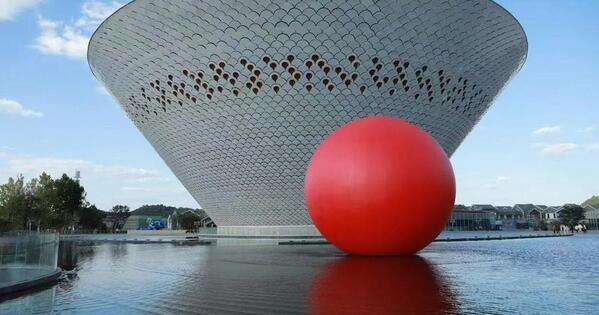
NANCHANG, May 10 (Xinhua) -- In Jingdezhen, a city long known as China's "porcelain capital," one of its newest landmarks appears almost as if it has emerged directly from a kiln.
It is a giant white "bowl," a smooth, eye-catching structure standing in Changnanli, a ceramic trendy-toy district in this eastern Chinese city.
Jingdezhen has been producing porcelain for more than 1,700 years.
Today, inside this bowl-shaped building, its ancient craft is being reimagined for a new global audience.
On the walls are familiar characters from some of the world's most well-known animation intellectual properties (IPs), including Nezha from China, Transformers from the United States and One Piece from Japan.
At the center of one exhibition hall stands Miffy, the Dutch cartoon rabbit once familiar to many Chinese children from school supplies, now dressed in a blue-and-white porcelain pattern.
The rabbit is part of Jingdezhen's first co-branded ceramic trendy toy created with the Miffy brand.
Small, cute and highly collectible, it also points to a larger experiment in how a city built on imperial kilns and export porcelain is learning to speak the language of contemporary pop culture.
"Ceramic itself has unique beauty in material and craftsmanship," said Yang Mingjun, curator of the Jingdezhen Youjian Dongfang trend art IP center.
"It is not only an artifact, but also a carrier of culture." Unlike most trendy toys on the market, which are typically made of plastic or resin, ceramic toys rely more heavily on material, firing techniques, handcrafting and finishing, Yang explained, noting that their appeal lies not only in their cuteness or collectability, but also in their tactile quality, craftsmanship and cultural depth.
For Jingdezhen, the shift is not simply about putting cartoon characters on porcelain.
It is about steering an old industrial and cultural system toward a new market.
Huang Hu, president and artistic director of the company operating Changnanli world ceramic trendy toys town, said Jingdezhen holds an advantage that is difficult to replicate, thanks to its more than 1,000-year-old porcelain-making traditions, a complete industrial chain, and a living system of craft innovation.
Porcelain-making in Jingdezhen is known for its precision and complexity.
The traditional process is often described as involving 72 procedures, from preparing clay and glaze to shaping, painting, decorating and firing.
Each step depends on the one before it.
Together, they carry the accumulated knowledge of generations of artisans.
That devotion to craft helped make Jingdezhen porcelain a "world commodity" centuries before the phrase existed.
In the city's Export Porcelain Museum, one object makes the point clear: a Qing Dynasty (1644-1911) porcelain shaving plate from the reign of Emperor Qianlong (1711-1799).
It has a broad rim, a folded form and a crescent-shaped notch cut into one side.
The pattern around the notch remains complete, suggesting that the piece was designed that way from the beginning.
Li Jing, who is in charge of the museum, said the plate was made for European aristocratic men.
When shaving, a man could rest his chin in the notch, allowing cut beard trimmings to fall....