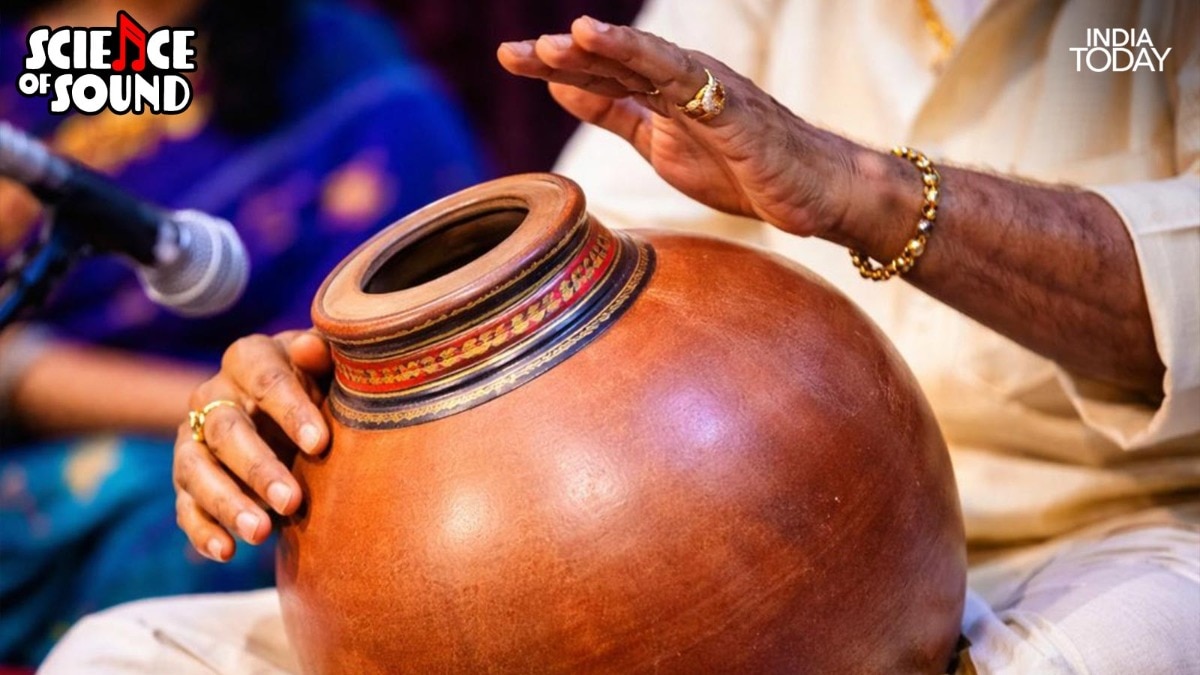
It looks like something you would carry water in: a round-bellied pot of baked clay, narrow-mouthed.
Then the musician draws it against his bare stomach, lays his fingers on the clay, and the pot begins to speak.A bass note that deepens as he presses the pot into his stomach, a clear high tone struck near the rim, and a fast flutter of fingers that races the beat and settles back upon it.The vessel is singing, and there is no trick.
The ghatam is the clay pot at the rhythmic heart of South Indian Carnatic music, fired in the Tamil Nadu town of Manamadurai from clay threaded with tiny shards of brass.
A ghatam player coaxes a full range of pitches from a single clay pot, deepening the bass by pressing its mouth against the stomach and drawing crisp, higher tones from near the rim.
(Photo: Unsplash) It carries a question the world took 2,000 years to answer: what kind of instrument is a singing pot?It has no strings, no skin stretched across it like a drum.
There is only the clay, the whole body of it trembling when the hand lands.To know where it belongs, beside the bell, not the drum, you need a system for sorting every sound made.
The Natya Shastra, Bharata Muni's treatise on performance, in Manomohan Ghosh's English translation.
(Photo: X) The West built one, named after two Germans, and treats it as the origin of the science of sound.But the logic at its heart was reasoned out in India 17 centuries earlier, written into a Sanskrit treatise called the Natya Shastra, and carried to Europe by an Indian scholar whose name the West forgot.This article, the latest instalment of the Science of Sound series, is the story of who answered first.
The next part will take up the German system that grew from this Indian foundation, and the science of why a raga moves us at all.THE FOURFOLD ANSWERSometime between the first century before the Common Era and the second century after it, a scholar named Bharata Muni completed that treatise, a work so ambitious it still has no real equivalent.It treats dance, drama, poetry, prosody, stagecraft and music as one science of performance, seven of its chapters on sound alone.In Chapter 28, Bharata makes a claim of extraordinary nerve.
Every musical instrument that exists or could ever exist, anywhere on Earth, can be sorted into four groups by the physical thing that vibrates to make the sound.
Four groups, he argues, are enough.
Four are necessary.
Four are complete.The first, tata vadya, is sounded by a stretched, vibrating string.
The veena, the sitar, the tanpura, and the violin are stringed instruments.The second, sushira vadya, by a vibrating column of air.
The flute, the shehnai, and the nadaswaram are wind instruments.
Shehnai maestro Ustad Bismillah Khan performs as sarod player Ustad Amjad Ali Khan looks on during their jugalbandi in Delhi on August 18, 2003.
(Photo: PTI) The third, ghana vadya, is a solid instrument of metal, stone, wood or fired clay that rings as a whole body.
Cymbals, bells, manjira, ghatam, and ghoongroo are solid instruments.The fourth, avanaddha vadya, is faced with a stretched membrane that beats when struck.
The drum, the tabla, the dhol, and the mridangam are percussion instruments.The ghatam, whose entire clay body vibrates when struck, is ghana vadya, akin not to the drum it sits beside on stage but to the bell.
Most of the finest ghatams come from Manamadurai in Tamil Nadu, where the clay is mixed with fine shards of brass to give the pot its bright, ringing voice.
(Photo: Unsplash) There is a quiet marvel in that placement.
The ghatam may once have been a drum: its earliest forms, some scholars believe, had a skin across the mouth, gone by the sixth century, after which the pot became a body that sings on its own.A single instrument had crossed from one of Bharata's classes into another, and his system catches that, because it never asks what an instrument is made of or called, only what, precisely, is vibrating.Those four divisions map, almost without a seam, onto the four primary classes that modern museums and scholars still use, the Hornbostel-Sachs classification.
A ghatam rests on its ring-shaped base, narrow-mouthed and round-bellied, looking every bit the ordinary clay pot it descends from, until a player presses its mouth to the body and the whole vessel begins to sing.
(Photo: Unsplash) According to a paper published by the German musicologists Erich Moritz von Hornbostel and Curt Sachs in 1914 and translated into English in The Galpin Society Journal, Vol.
14, in March 1961, musical instruments can be divided into four classes: chordophones, aerophones, idiophones and membranophones.Chordophones are stringed instruments, aerophones have a vibrating column of air, idiophones produce sounds through the vibration of the entire solid body, and membranophones have a stretched skin.The Hornbostel-Sachs classification system arrived 17 centuries after Bharata, who devised the Natya Shastra not by sorting instruments by resemblance but by reasoning from physics.
A bronze Nataraja, Shiva as the lord of dance, ringed by a circle of flame.
The same image presides over the Natya Shastra, the treatise that wove dance, drama and music into a single science of performance.
(Photo: X) The principle sounds almost too plain to be powerful.
A string vibrates.
A column of air vibrates.
A solid body vibrates.
A membrane vibrates.
Acoustically, that exhausts the possibilities.
Everything else is elaboration on one of those four events.“All instruments, anywhere in the world, invariably come under one of these classifications,” musicologist and educationist Pappu Venugopala Rao renders directly from the music chapters of the Natya Shastra.Two thousand years on, the claim holds.
The only large thing modern organology, or the science of how we classify instruments, has added is a fifth class, electrophones, which carry sound through electronic circuitry.
A notched wooden scraper, played by drawing the rod across its carved ridges so the body itself rasps and rings.
It is an idiophone, or ghana vadya in the Natya Shastra, the same family of solid sounders as the bell, the gong and the clay ghatam.
(Photo: X) This new class was folded in by the MIMO Consortium, a partnership of instrument museums, in 2011.
A man writing before the Common Era can be forgiven for not anticipating the synthesiser.What is so often missed is that the Natya Shastra was not idle speculation.
It is full of working acoustics.Bharata described measuring the 22 shrutis, the microtonal steps into which Indian music divides the octave.A string makes sound by vibrating, and the faster it vibrates, the higher the pitch.The number of vibrations per second is its frequency, and two strings are in tune when their frequencies match exactly, sounding as one.
A shruti is the smallest difference in pitch the human ear can detect.
A 19th-century engraving of an Indian musician with a gourd-resonator string instrument, a tata vadya, or string sounder, in the Natya Shastra's scheme.
Such images carried Indian music into the Western eye in the very decades Tagore was exporting its theory.
(Photo: X) Imagine sliding orange toward red, shade by shade: the last point where you can still tell them apart is one shruti.Bharata's method was this, in sound: he tuned two identical veenas alike, then loosened one string by the tiniest amount, until the two stopped sounding unified, and the ear caught them as two notes.That gap was the measurement.
A note is what the ear hears when an object vibrates at one steady frequency, a regular wave rather than the chaotic jumble that makes noise.So, plainly: pitch is the quality of highness or lowness of a sound, a tone is a smooth sound with a clear pitch, and a note is a named tone musicians build music from.
Bharata Muni, author of the Natya Shastra, in a metal relief beside a dancing Nataraja, part of a waste-to-art installation in Delhi.
Both Indian and Western music name seven notes, Sa Re Ga Ma Pa Dha Ni and Do Re Mi Fa So La Ti, but these are just the main notes, and there are smaller steps hidden between them.The West splits the octave into 12 of these small steps, while Indian classical music splits the very same stretch into 22 even finer ones called shrutis, the way a millimetre ruler sees distances a centimetre ruler misses.Bharata gives a whole chapter to tala, the architecture of musical time, writing bluntly that a musician who does not know rhythm is fit neither to sing nor to play.This was a civilisation measuring sound exactly, long before it owned any instrument but the....