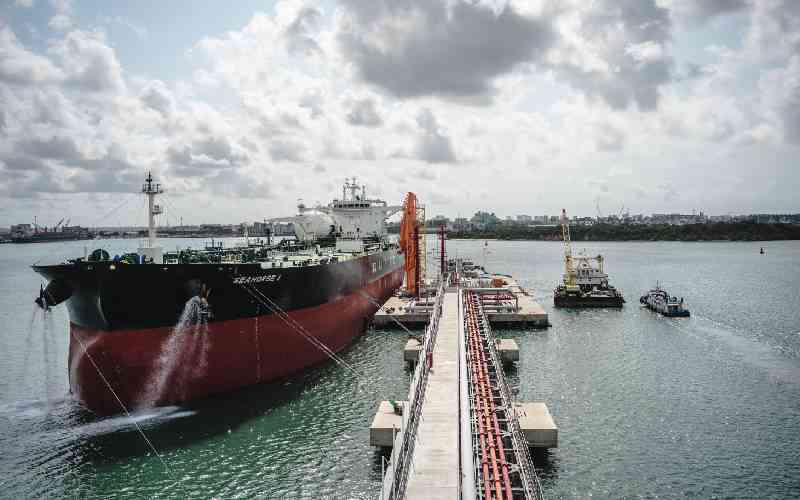
This photo taken on August 15, 2024, shows a view of the Kenya Mombasa Oil Terminal built by the China Communications Construction Co Ltd.
[File, Standard] There is a seductive simplicity in the narrative that China’s expanding footprint in African ports is merely about infrastructure, efficiency, and trade facilitation.
New berths, deeper drafts, modern cranes, and digitised logistics chains all point to a continent finally correcting its historical deficit in maritime capacity.
But beneath this visible layer lies a more consequential reality: ports are no longer passive gateways of commerce.
They are instruments of power, influence, and long-term strategic positioning.
A host of maritime experts, following keenly the latest developments, shared their insights with Shipping and Logistics.
Former Seafarers Union of Kenya (SUK) Secretary General and maritime commentator Andrew Mwangura said the emerging pattern across Africa is unmistakable.
“Chinese entities are not only financing port infrastructure but also building, operating, and integrating these assets into global supply chains that connect Asia, Europe, and the Americas.
This is not a fragmented or opportunistic investment approach; it is structured and sequential,” Mwangura said.
He stated that finance leads to construction, construction to operational control, and operational control to integration within a broader logistical ecosystem.
The result is a network that enhances trade efficiency while simultaneously embedding geopolitical optionality.
“It is this duality that makes the current moment so critical for Africa,” he said.
Mwangura further explained that on the one hand, the benefits are tangible and immediate.
“China’s investments—estimated at tens of billions of dollars over the past decade—have expanded Africa’s export capacity, reduced transport costs, and improved connectivity to global markets.
Ports that once suffered from congestion, shallow drafts, and inefficiency are now capable of handling larger vessels, faster turnaround times, and more complex cargo flows.
The outcome is a measurable boost in competitiveness, particularly for commodity exports such as oil, minerals, and agricultural products,’’ he said.
Ezra Owens, a regional expert in fisheries based in the Indian Ocean island nation of the Seychelles, said these ports are becoming nodes of concentrated influence.
“Control over port infrastructure increasingly translates into influence over trade flows, freight pricing dynamics, and access to strategic resources.
The ability to monitor, prioritise, or even disrupt cargo movements—whether for commercial or strategic reasons—introduces a new dimension to global trade, one where infrastructure ownership shapes market power,” Owens said.
“This is why the phrase ‘control the ports, control the flows’ is more than rhetoric.
It is a reflection of how modern trade operates,” he said.
Mwangura stated that historically, ports were seen as neutral public utilities—essential but politically benign.
That assumption no longer holds.
“Today, ports are deeply embedded in the geopolitics of supply chains.
They determine....