In Silicon Valley and beyond, the architects of artificial intelligence are increasingly warning about the risks it poses to humanity.
Anthropic CEO Dario Amodei wants the industry to slow down.
A former engineer at his company, who also worked at its rival OpenAI, told reporters after quitting earlier this month that he was “genuinely frightened” unchecked AI development might mean “we could all die in the immediate future”.
Even Geoffrey Hinton, the Nobel Prize-winning computer scientist known as the “godfather of AI”, has warned of the existential threat posed by the technology should it escape human control.
Concerns about AI run the gamut from autonomous weapons, mass unemployment and machine-driven cyberattacks to deepfake-fuelled misinformation, algorithmic bias and a dangerous overreliance on automation.
South Korea has seen all this – and decided now is the time to hit the accelerator.
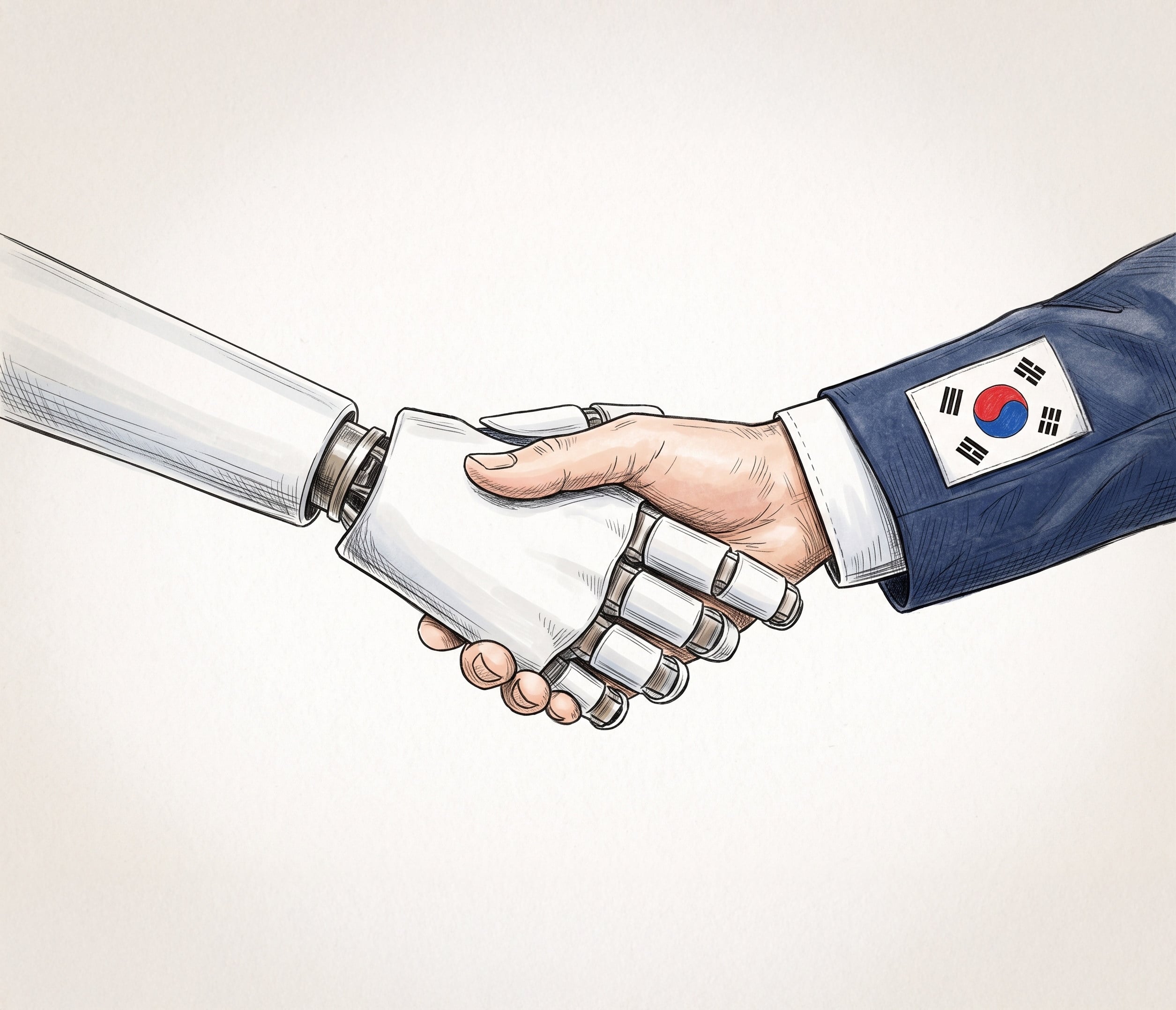
Under President Lee Jae Myung’s “AI for All” initiative, the government is preparing to hand every citizen free access to artificial intelligence, integrating it into hospitals, schools, government offices and daily lives in a way few countries have attempted.
“The idea is to substantially lower barriers to access so that the benefits of the technology are distributed evenly rather than enjoyed by only some people,” Seoul’s Ministry of Science and ICT said in a statement to This Week in Asia.
The government, which has a 10 trillion won (US$7.3 billion) AI budget for the current financial year, has allocated an additional 250 billion won for the roll-out through 2027.
A beta version is set to launch later this month, introducing free, unlimited-access general-purpose chatbots and AI agents developed by three consortiums – led by telecoms giants SK Telecom, KT and Kakao – using hundreds of state-of-the-art Nvidia B200 graphics processing units lent to them by the government.
From next year, officials envisage the temporary trial will become a permanent, taxpayer-funded public utility, eventually connecting to government systems to allow citizens to book doctor’s appointments, go house hunting, get tax advice and the like, all through AI intermediaries.
To manage the risks involved, Seoul is relying on its landmark AI Basic Act, which came into force in January, to ensure human-in-the-loop oversight, mandatory impact assessments and clear watermarking of synthetic content.
Meanwhile, a state-funded AI Safety Institute has been tasked with serving as a technical watchdog to evaluate the pitfalls and ensure that public AI utilities remain trustworthy, secure and answerable to the citizens who use them.
“Going forward, the government plans to establish an autonomous reliability-assurance system”, the ICT ministry said in its statement, adding this would be based on the seven “AI Ethics Principles” it laid out last month: accountability, human-centredness, privacy protection and fairness among them.
South Korea hopes its “AI for All” push will help it become one of the world’s three leading AI powers, alongside the United States and China, with the government seeing the technology as an antidote to a shrinking workforce and as a way to strengthen its export-driven economy.
But the same society racing to put AI in every pocket is also confronting the consequences of what that means, as workers worry about automation eliminating jobs, police struggle to combat a surge in deepfake crimes and educators watch a generation’s reading scores slide.
Sovereignty is another concern.
Of the roughly two-thirds of South Korea’s 51.6 million people who have tried or regularly use AI, 23.45 million are active users of OpenAI’s ChatGPT, 8.45 million of Google’s Gemini and 2.41 million of Anthropic’s Claude, according to government figures.
Yet access to these platforms cannot be guaranteed, as the ministry noted in its statement.
“As we saw recently, foreign AI services can have their availability limited at any time depending on decisions made by foreign governments or companies,” it said, in a possible nod to Washington’s recent attempts to block access to the newest models.
In July, Science and ICT Minister Bae Kyung-hoon unveiled plans for South Korea to develop its own cybersecurity-focused AI model by the end of this year, following the US clampdown.
Brewing with bots At Unicup Coffee, an independent cafe vying for business against 11 low-cost chain rivals in Busan International Finance Centre, owner Bae Kyung-han, 31, credits AI with helping him beat the competition.
What began a year ago as a cost-saving experiment, with Bae teaching himself how to use generative AI to create promotional posters and menu images, has since taken over nearly every part of the business.
“It’s now running my research, proposal developments, communications and advertisements,” he said, adding that the AI system – his only office-based “colleague” – had also orchestrated a shift in focus towards bulk orders instead of walk-in customers.
Five employees handle customer orders, serving some 13,000 people a month and generating card sales that are, according to Bae, roughly double those of his competitors.
He has also built a second business around the technology, registering as a vendor under one of the government’s chosen AI consortiums to teach novices how to ask better questions of their chatbots.
“The biggest advantage of AI in the workplace is that it reduces the psychological burden of managing people,” Bae said, describing the relief of no longer having to coordinate schedules, repeat instructions or manage employees’ feelings.
“With AI, I can ask questions whenever I need to and revise plans whenever I want to.
It’s just more efficient.” Yet he is still sceptical of the government’s AI strategy, questioning whether domestically developed models – even ones that are provided for free – would actually be able to wean people off premium foreign made tools.
“People who are used to using AI would likely pay for a more expensive US-based model like ChatGPT rather than use a free domestic service,” Bae said.
That is, unless the models were specialised and purpose-built for specific problems, as opposed to another general-purpose chatbot.
“That changes the conversation,” Bae said.
“That could do wonders for businesses like mine.” Elsewhere, at a jobs fair in Seoul’s Yonsei University, technology companies crowded the floor, competing for the attention of soon-to-be graduates before they had even finished their degrees.
Kwon Il-geun, an electronic engineering student hoping to work at semiconductor giants Samsung Electronics or SK Hynix, said AI proficiency had never been more important.
“My skills in using AI tools have nearly doubled in the past year,” he said, comparing the shift to the first industrial revolution or the arrival of the personal computer.
“This is just part of the changing times.” No juniors needed? Not everyone is sharing in the spoils, however.
The number of young South Koreans aged 15 to 29 who were in work dropped by 285,000 between June 2022 and June this year, according to the central bank, which estimated that 94 per cent of that decline was in sectors highly exposed to automation, including publishing, IT services and computer programming.
And the Korea Development Institute, a government-run think tank, projected in July that AI could wipe out roughly 256,000 jobs a year within the next decade.
This has had a knock-on....