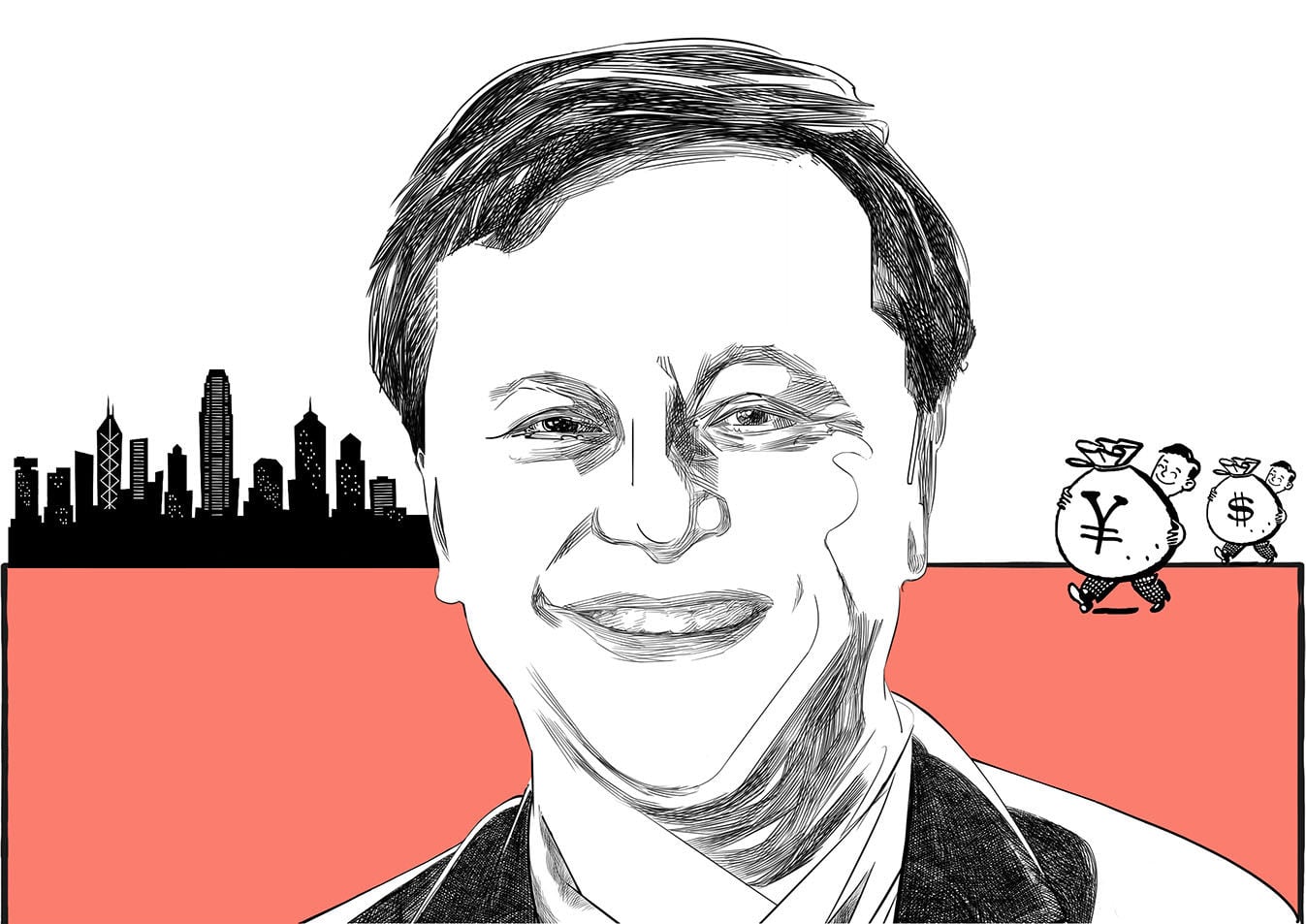
Charles Li Xiaojia, the longest-serving CEO of Hong Kong Exchanges and Clearing (HKEX), defined a decade of city finance by bridging the gap between Chinese and global capital.
From his early days as an offshore oil worker in northeastern China to serving as chairman of JPMorgan Chase’s China division, Li’s career has resembled China’s own economic opening.
In his 11 years as HKEX CEO before stepping down in 2021, Li masterminded the landmark Stock Connect schemes, linking Hong Kong with Shanghai and Shenzhen.
He also pushed through contentious reforms allowing dual-class shares and pre-revenue biotech listings, helping transform the city into a tech-fundraising hub.
Now the co-founder of Micro Connect, Li is focused on bringing institutional capital to China’s small businesses.
This interview first appeared in SCMP Plus.
For other interviews in the Open Questions series, click here.
How are shifting geopolitical tensions and war in the Middle East affecting Hong Kong’s capital markets? The impact of geopolitical tensions on Hong Kong is not fundamentally different from that on global markets.
Obviously, hostilities in the Middle East or Ukraine have a slightly less direct and more remote impact here because we are not primarily an oil or commodity market.
The more interesting reality is that Hong Kong sits at the epicentre of the world’s two superpowers – the United States and China.
When you are important to both markets, both dictate your market sentiment.
As the Chinese idiom goes, “blessings rarely come in pairs, but misfortune never comes singly”.
Because we are the most sensitive link between these major powers, global volatility has a much greater impact on our market.
That is the nature of our market.
For the longer term, we will prevail, we will survive, we will thrive.
But I could not tell you in the next six months whether it is going to be good or bad.
We shouldn’t treat this market as if it were a fickle child constantly reacting to every swing in sentiment.
Next year marks the 30th anniversary of Hong Kong’s return to Chinese sovereignty.
How do you view the evolution of the city’s stock market over that period? The role of our capital market has transitioned through three stages in the past three decades.
Stage 1.0 supported capital formation in China.
Since the early 1990s, Hong Kong’s capital market has helped Chinese enterprises raise funds by issuing shares and bonds in the city to finance their development.
This was a successful, one-dimensional fundraising model.
Stage 2.0 was much broader.
Since the 2000s, we have positioned Hong Kong as a jumping-off point for international capital to enter China.
This stage matured further with the 2014 launch of the first Stock Connect scheme between Shanghai and Hong Kong, which expanded to Shenzhen in 2016 and eventually to additional asset classes such as bonds and wealth-management products.
The significance of 2.0 was the convergence of international and domestic Chinese capital in Hong Kong.
Under these connect schemes, international investors can come to Hong Kong to invest in a much broader spectrum of China’s economic growth via the northbound connect schemes, which allow them to directly invest in the mainland stock and bond markets.
Chinese capital can also be invested in Hong Kong-listed companies and bonds via the southbound channels, allowing mainland investors to invest in stocks and bonds in the city.
We are now at the beginning of Stage 3.0 – transforming into a capital-formation hub for international companies, not just Chinese ones.
In this stage, mainland investors will play a far more prominent role.
What specific reforms are needed for Hong Kong to realise this “3.0” vision? It will involve the “primary connect”, or, as some would like to call it, the “IPO connect”.
At present, there is no compelling reason for many non-Chinese companies to list in Hong Kong.
Unless there is something unique that Hong Kong can provide them, those candidates will go to a market like New York, or to London, Singapore and other places.
This is why more than 90 per cent of Hong Kong initial public offerings are by mainland companies, which account for 80 per cent of market capitalisation and turnover.
The primary connect will incentivise international firms to list in Hong Kong by allowing domestic Chinese investors to subscribe to their IPOs.
There is a compelling reason for two large segments – global energy and resource firms – to list in Hong Kong if we bridge that gap with an IPO connect.
In energy- and resource-rich countries, sovereign-owned companies are China’s biggest providers of energy and raw materials.
Since China will remain their biggest customer for decades to come, there is an inherent need for both sides to build much greater connectivity beyond a simple customer relationship.
The IPO connect aims to create a capital linkage on top of the commodity linkage, turning Chinese buyers into shareholders.
I view this as the swap of the century – a debt-equity swap and an ownership swap.
A big sovereign-owned company such as Saudi Aramco has little reason to list here today, but if the southbound Stock Connect allowed Chinese capital to subscribe to IPOs or primary listings of those big international companies, it would be a different story.
Why is it vital for Chinese buyers to move from being customers to shareholders in these global giants? Nowadays, Chinese companies are merely customers exposed to volatile commodity prices.
By becoming shareholders, China secures a natural hedge.
When commodity prices, such as oil or gas, rise, customers suffer but shareholders benefit.
Conversely, if commodity prices fall, our customers are happy but shareholders suffer.
Furthermore, once these companies sell shares to Chinese buyers, the firms receive yuan that can be used to buy Chinese treasuries and diversify balance sheets.
This creates a deeper energy and commodity relationship, and Hong Kong is the one venue that can facilitate that.
The key to Stage 3.0’s successful market evolution hinges on opening the southbound connect to yuan-denominated IPO subscriptions.
But we need to realise that, in the beginning, it would be limited to some sovereign-owned energy and resource companies that would be interested in this because they are the ones able to use the yuan to make investments.
If that happens, Hong Kong would become a destination for capital for many big international companies.
And more international investment banks would come to Hong Kong because they would have to take into account how Chinese investors are reacting to those international underwriters.
The yuan is not yet a currency for everybody, but it can become a currency for sovereign balance sheets The Chinese government has advocated for the yuan to become a global reserve currency.
What is Hong Kong’s role in that process? The internationalisation of the yuan, including as a global reserve currency, is a long-term aspiration of China as a superpower.
For a currency to become a true international reserve, it must be fully and freely convertible, which is unlikely in the near term.