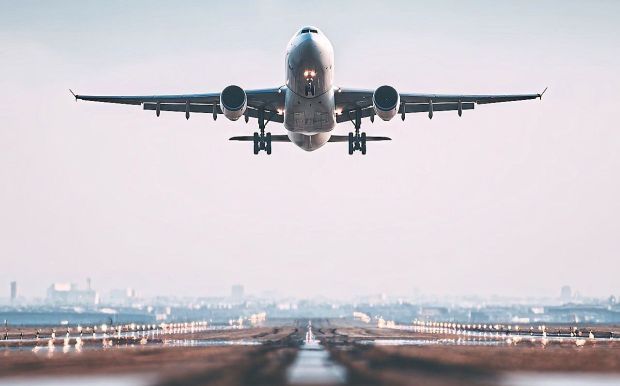
EVERY time you board a flight at KL International Airport, you are quietly leaving behind the protective blanket that has been keeping you safe your entire life.
That blanket is the Earth's atmosphere, and at cruising altitude, the universe has some rather uninvited things to send your way.
Does flying on a plane actually expose you to significant radiation? TRUE, BUT...
Commercial aircraft cruise at altitudes of between 7,000 and 12,000 metres, well above most of the atmospheric shielding that protects people on the ground from cosmic radiation.
Cosmic radiation consists of high-energy particles originating from outside the solar system, including from distant supernovae, as well as charged particles released by the sun.
When these particles collide with molecules in the Earth's atmosphere, they produce secondary particles, some of which reach the ground as background radiation.
At cruising altitude, significantly more of this radiation reaches passengers and crew because most of the atmospheric buffer has been left behind.
According to the US Centres for Disease Control and Prevention, the amount of radiation received during a flight depends on three main factors: the duration of the flight, the altitude, and how far the route is from the equator.
The Earth's magnetic field deflects cosmic radiation most effectively at the equator and least effectively near the poles, meaning that polar and high-latitude routes receive considerably more radiation than equatorial ones.
This is actually good news for Malaysian travellers.
Flights departing from Kuala Lumpur to regional destinations such as Bangkok, Jakarta or Singapore operate close to the equator and receive radiation dose rates two to three times lower than equivalent flights on higher-latitude routes, according to the US-based Health Physics Society.
A research paper published in the journal Space Weather estimated that a transequatorial flight between Colombo and Jakarta resulted in a total effective radiation dose of just 9.7....