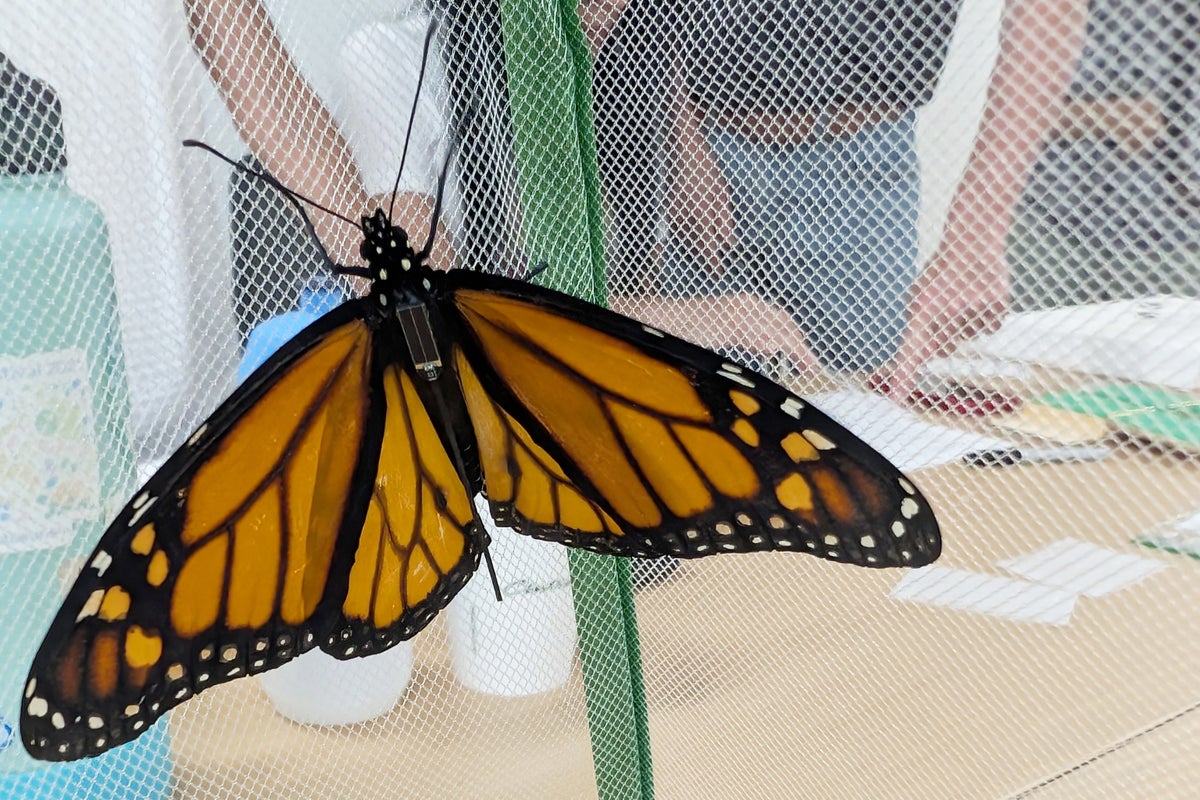
As a child, Rebeca Quiñonez-Piñón wondered where monarch butterflies stop for a meal and a night's rest on their long migrations across North America.
Now she and other scientists are attaching tiny tracking devices to hundreds of butterflies to find those critical stopover locations before they disappear.
Swarms of dazzling orange-and-black monarchs use environmental cues to travel some 3,000 miles (4,800 kilometers) from as far as southern Canada to spend the winter in forests of oyamel fir trees in central Mexico, a protected biosphere reserve that's also a World Heritage site.
For decades, however, scientists have struggled to build a clear picture of the butterflies' routes, how far they fly each day and where they settle at night.
Solar-powered radio tags attached to nearly 1,750 monarchs this year are helping provide answers.
As habitat loss, pesticides and climate change pummel monarch populations, the research could help their numbers rebound.
Quiñonez-Piñón said the uniquely famous monarch butterfly helps draw attention to the threats facing insects and their vital role in sustaining plant life across the continent.
“Pollinators are crucial to protect and ensure that our ecosystems remain healthy,” she said, “and also to have the sources of food that we require as humans.” The public can follow the progress of individual butterflies on the free app called Project Monarch Science.
Tracking monarch butterflies in the ‘Texas funnel’ and beyond Quiñonez-Piñón is the senior scientist at the National Wildlife Federation, a nonprofit that recently joined a tri-national science team to track monarchs.
She’s leading a study that mixes real-time migratory tracking with community science to better understand where they stop in Texas.
Only some monarchs migrate.
Of the ones that do, a big portion of the butterflies east of the Rocky Mountains fly through a narrow corridor known as the “Texas funnel” every fall and spring, when they head north again to lay their eggs before dying.
But depending on the year, they might favor different parts of the Lone Star State, based on where they can find water, nectar and overnight shelters like trees.
It’s a detail that has fascinated scientists, including Quiñonez-Piñón.
Since the tracking started last year, scientists have found the first evidence of a butterfly in Utah, west of the Rockies, joining eastern monarchs in central Mexico.
Others migrated down the Eastern Seaboard to Florida, jumped the Gulf of Mexico and are now tracking across Mexico, a connection scientists hadn’t seen before in such numbers.
“There’s just all these unique stories of their paths, connections between the population, that we didn’t know existed or we hypothesized but couldn’t prove,” said Emma Pelton, senior conservation biologist with the Xerces Society for Invertebrate Conservation.
“We’re a year into it, and I think we’re all just thrilled,” she said, especially since older tracking devices proved too big or heavy.
Since their migration started this year, about 175 tagged butterflies have been detected in Mexico.
Only some monarch butterflies get tracking devices The new $200 tags weigh about as much as a drop of water and were developed by Cellular....