BAMENDA, Cameroon (CNS) — “The voices in the bushes.” That is the fear that defines daily life for many residents of this city in Cameroon’s troubled Anglophone region.
“You don’t know where they are,” Cajetan Nfor told Catholic News Service April 16.
“You don’t know how many of them there are.” A resident of Bamenda since 1964, Nfor has witnessed firsthand the rapid decline of the city he calls home.
What began in 2016 as a political protest movement led by English-speaking teachers and lawyers over claims of professional and political marginalization by Cameroon’s French-speaking majority government quickly escalated into violence.
Armed separatist groups emerged in the Anglophone regions, initially with some support from residents.
But as time went on, the movement shifted, and the separatist groups began terrorizing their own.
Armed groups began abducting civilians, looting businesses and enforcing their control through fear.
Today, residents in northwest Cameroon say they live caught between separatist fighters and government forces, both capable of violence.
Human Rights Watch estimated in 2024 that more than 6,000 civilians have died at the hands of both sides after a decade of conflict.
Thousands have been kidnapped, many killed, while others have been sexually assaulted, beaten and held for ransom.
Among them was Sister Carine Tangiri Mangu, a Sister of St.
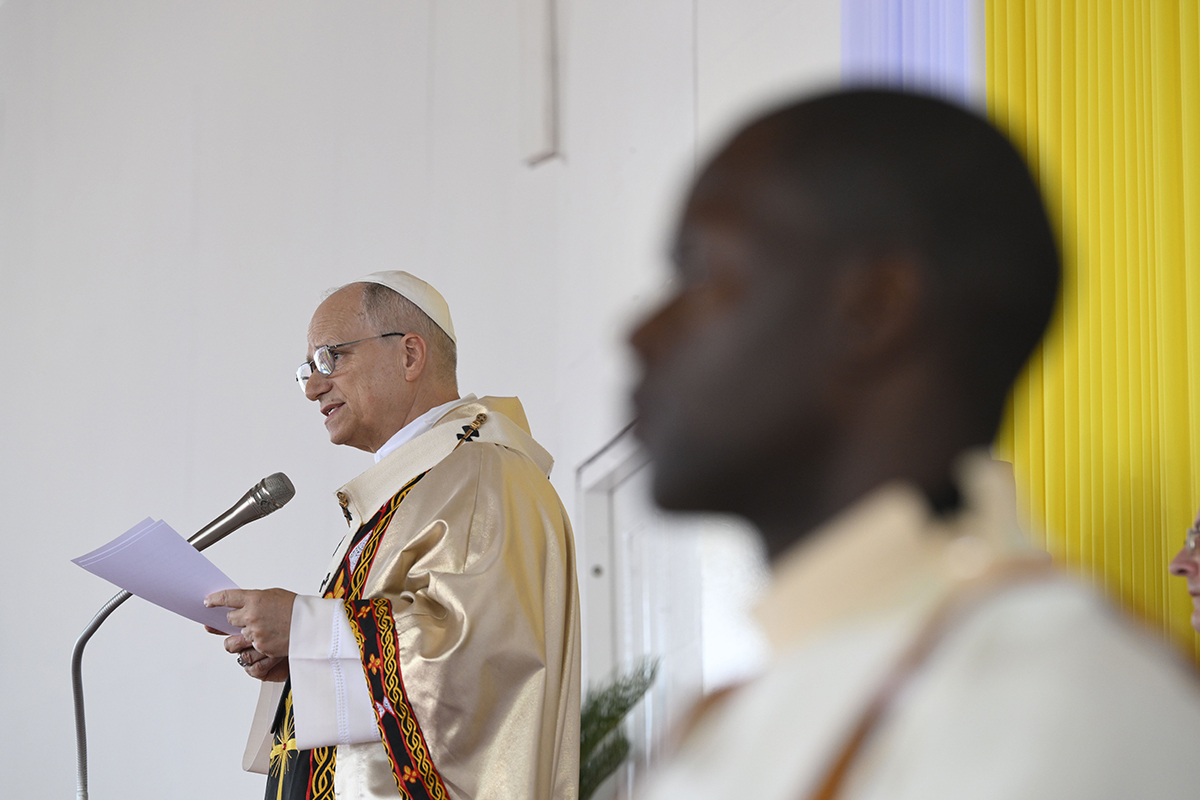
Anne, who told Pope Leo XIV during a community meeting April 16 that she and a priest were taken “into the bush” in November 2025 and held for three days.
They were denied food, water and sleep.
“We went on hunger strike and explained to our captors that we were just doing our work for the poor people and had nothing to do with the politics,” she said at the meeting, which included local representatives from different faiths and traditions.
“They demanded us to give telephone numbers so that they could collect ransom.” They prayed the rosary continuously, she said and were eventually freed after local Christians negotiated their release.
Other residents at the meeting with the pope shared similar accounts with Catholic News Service, describing abductions for ransom and beatings carried out while family members listened over the phone.
Civilians living in fear Anglophone separatist groups in Cameroon, which began fighting for independence of the country’s English-speaking regions, have increasingly turned to criminal activities to finance their rebellion, alongside a rise in violence against civilians.
In the first half of 2024, the northwest region ranked as the second most dangerous administrative area for civilians in Africa, behind only Al-Jazirah state in central Sudan, according to the Armed Conflict Location & Event Data Project.
In addition to their fear of the separatists, many residents fear suspected reprisals from the military.
Twice in the span of a week last month, Nfor said he woke up to gunshots on his street.
Both times, he stepped outside to find the corpses of two residents sprawled on the road, roughly 500 meters from his home.
His road, he said, has become a “dumping ground,” where heavy rains can wash the corpses away.
He believes those killed were victims of “regular enforcements of law and order.” Human Rights Watch reported in 2024 that the military has been known to target local civilians outright.
Before the crisis, he remembers a very different Bamenda — a vibrant city of 630,000, where this kind of fear did not linger.
“You can imagine a river, just rumbling slowly going, and you are on a boat enjoying the ripples,” Nfor said.
“That was the kind of life that was here.” That life has completely disappeared.
Once one of the country’s most economically active cities, Bamenda has been hollowed out by years of conflict.
Business owners have fled after repeated looting and abductions.
Farmers struggle to work their land for fear of abduction and killings.
Roads are dangerous as separatists have strongholds along major routes, and goods rarely move freely.
Food prices have soared, and access to medical care is limited as the region has become increasingly cut off.
“No one stays out after 7 p.m.,” Nfor said.
“If you are still hanging out and you don’t have transport… it becomes impossible.” Even short journeys have become ordeals.
Trips that once took a few hours can now take up to half a day, as drivers avoid conflict zones.
For Joseph Kitu, the violence has made returning to his home village impossible.
“For the past ten years, our lives have been miserable,” he told CNS while waiting for the pope to arrive at the community meeting.
“We have lost relatives.
They burned homes, looted our properties.
I’m an orphan.
My parents have all died because of this.” The pope’s message of peace As soon as Pope Leo arrived in war-torn Cameroon April 15, he did not shy away from bringing a message of peace that directly confronted the suffering the people face every day.
In clear, direct language, the pope spent his time in Cameroon denouncing violence, corruption and exploitation, while calling for reconciliation and credible leadership.
He has repeatedly framed peace not as an abstract ideal, but as a responsibility shared by political leaders, communities and individuals alike.
When addressing the diplomatic corps in his first stop to Cameroon, he urged leaders to move beyond paralysis and fear.
“We are living at a time when hopelessness is rampant and a sense of powerlessness tends to paralyze the renewal so deeply desired by peoples,” he said in Yaoundé at the presidential palace April 15.
“There is such a hunger and thirst for justice! A thirst for getting involved, for a vision, for courageous choices and for peace!” The pope began his call for peace in the country during an address to the diplomatic corps and 93-year-old President Paul Biya, who has been in power since 1982 and whose long rule has drawn criticism from opposition figures and human rights groups.
Quoting his spiritual father, St.
Augustine, the pope said the saint believed those who rule should do so to serve the people, and they should rule “not from a love of power, but from a sense of the duty they owe others.” “From this perspective, serving one’s country means dedicating oneself, with a clear mind and an upright conscience, to the common good of all people in the nation,” he said.
Throughout this leg of his apostolic journey, which covered hundreds of miles and three cities, Pope Leo condemned what he described as a global system that fuels conflict for gain.
After residents described fear, loss and exhaustion during the April 16 meeting, the pope....