The intensification of aerial and satellite surveillance over the Strait of Hormuz marks a decisive shift in how great power rivalry can unfold.
Rather than take on each other through direct naval confrontation alone, the big powers can also engage in persistent observation, tracking, and strategic signalling.
What appears, at first glance, as a technical adaptation by the US Navy is, in fact, a profound geopolitical recalibration shaped by vulnerability, deterrence, and economic interdependence.
At the heart of this transformation lies a simple but dangerous reality: the Strait of Hormuz is no longer merely a maritime chokepoint.
It has become a contested surveillance theatre where intelligence gathering risks are interpreted as provocation.
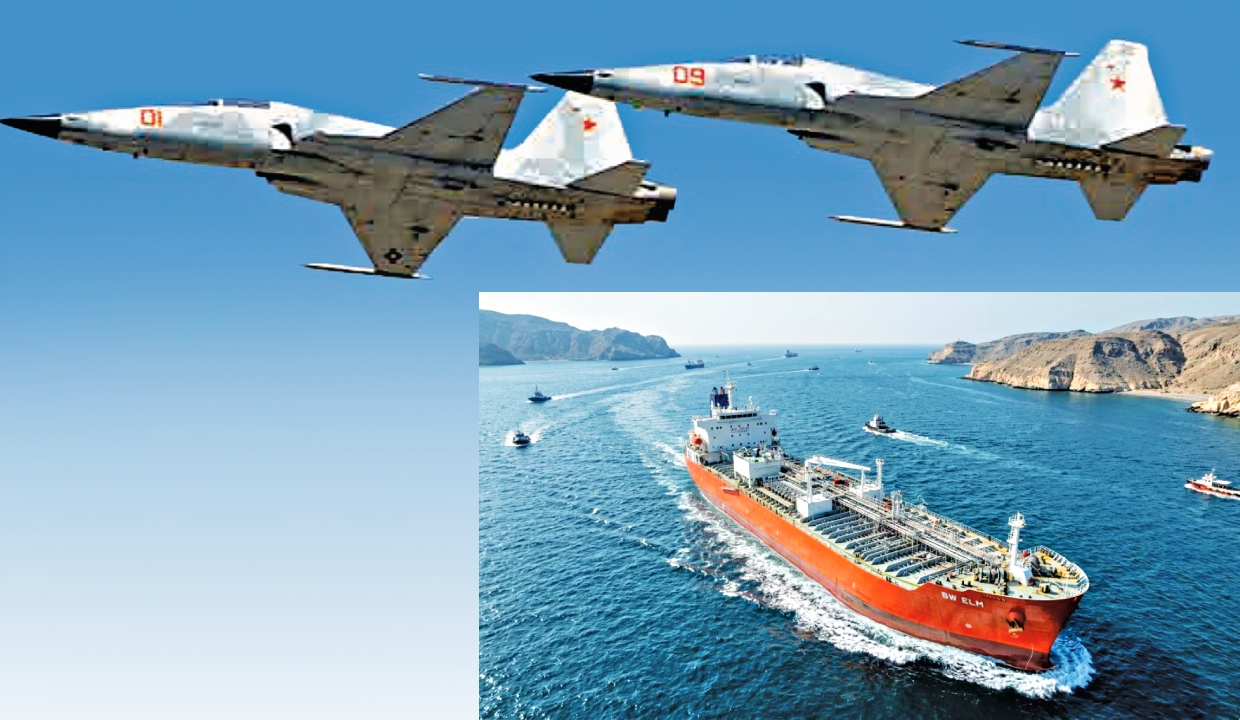
The US, acutely aware of the dense network of anti-ship missiles, drones, and swarm tactics employed by Iran’s Islamic Revolutionary Guard Corps (IRGC), has found its traditional naval dominance constrained.
The proximity required for surface fleet operations in such a narrow waterway — at points barely 21 miles (33.7km) across — renders even the most advanced naval assets susceptible to asymmetric attacks.
As a result, Washington has pivoted towards aerial reconnaissance and satellite monitoring as safer alternatives to track Iranian tanker movements.
Yet this shift is not without consequence.
China, which imports approximately 13% of its crude oil from Iran for total energy consumption, is not merely a passive observer in this unfolding drama.
IRCG, for its part, sells up to 90% of its oil exports to Beijing.
This deep energy interdependence transforms what might otherwise be a bilateral US-Iran confrontation into a triangular strategic dilemma involving China.
How? Every satellite image captured, every drone flight conducted, and every tanker tracked by the US Navy, say, in the Indian Ocean, carries with it the implicit possibility of interception.
That’s the US’s interception of Iranian vessels heading for China.
Will China just sit and not escort the Iranian vessels to China too? This is now a major question confronting China, the US and Iran.
Thus, should the US move from surveillance to interdiction — whether through sanctions enforcement or physical disruption — it would not only target IRGC’s revenue streams but also directly affect China’s energy security.
This is where the geopolitical calculus becomes perilous.
China cannot afford to remain neutral if its energy lifelines are threatened.
The logic of great power politics dictates that Beijing may be compelled to respond — diplomatically at first, but potentially in more assertive ways — should Washington attempt to interdict vessels bound for Chinese ports.
China, after all, has a solitary naval base in Djibouti too.
Not that far from Red Sea, the Strait of Hormuz, the Persian Gulf and the Indian Ocean.
The result is a triage of tension in which Iran seeks to sustain its economic survival, the US attempts to enforce strategic pressure, and China strives to secure uninterrupted energy supplies.
But that is not all.
The situation becomes even more complex with the inclusion of India.
New Delhi, another significant importer of Iranian....