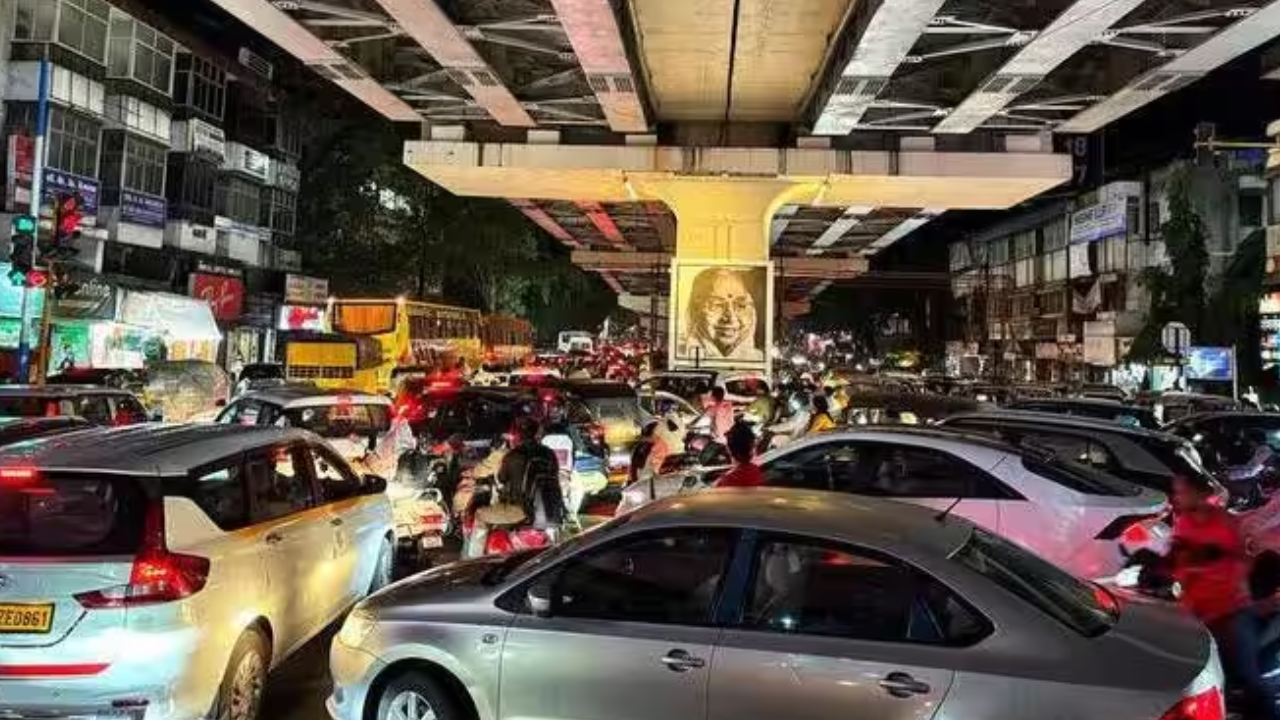
Pune has become synonymous with traffic chaos in the last few years.
As per the TomTom Traffic Index, a live traffic monitoring website, traffic congestion here went up to 71.1% in 2025 from 65.7% in 2024, a swift rise of 5.4 percentage points.In the same period, Pune Municipal Corporation (PMC) and state govt announced multiple flyover projects, in a bid to resolve snarls and improve vehicular flow.Experts, activists and citizens ask, however: Are flyovers the solution? Many have pointed out that building flyover projects for hundreds of crores of rupees doesn’t really resolve anything — it just causes pooling of traffic below or at both ends of the flyover instead.Take Nal Stop flyover for instance.
For vehicles heading from Karve Road towards Kothrud, taking the higher road and avoiding the junction below is a cakewalk.
Travel time and being stuck in jams has reduced for these commuters.
But, for those who still have to use the Law College Road to Kothrud route via Nal Stop below the flyover, peak-hour trips are nothing short of a nightmare.Pushkar Tyagi, a student who uses this route from Senapati Bapat Road to Karvenagar daily, said, “I dread evening commutes because of this junction.
SNDT Metro station, a bus stop and the flyover all converge.
Buses that use the flyover suddenly take a left; other vehicles that use the at-grade road turn right, mostly to join the second flyover barely metres away.
This always causes confusion.
The queue snakes back into Law College Road and takes over the entire Nal Stop junction, becoming a hindrance even for those trying to go from Kothrud to Deccan without opting for the flyover.”“If a youngster like me can understand bad design, what are authorities or contractors hired to make these junctions thinking when they plan it?” he asked.Commuters using the 2.5km-long Sinhagad Road flyover have also observed that travelling on this bridge has become a timing game.
Restaurant owner, Gaurav Kadam who travels daily from Dhayari to Karvenagar, said, “In non-peak hours, Sinhagad Road flyover is a great option.
But peak hours are no better than they were before.
Traffic gets blocked on either end of the flyover.
Commuters spend the same time in traffic, if not more, than they did earlier.”IT professional Devayani Belsare, who frequently travels to and from Prabhat Road and Kothrud, said her route depends on the time of day.
“I tend to go one junction back to join Karve Road because of traffic at Nal Stop.
Thereafter, I have two options — either go all the way to Sahyadri Hospital to take a U-turn or join a smaller bylane and take a U-turn before turning left onto Karve Road.
For those at the junction, a right turn is not allowed.
Decisions like this encourage motorists to break rules.
Commuting should be made easy, not complicated or tiresome,” the 29-year-old said.In-depth study crucial for long-term solutionAccording to the Indian Roads Congress (IRC) manual for grade separators and elevated structures, planning of urban flyovers is guided by considerations of safety, efficiency and economy of traffic operation across major intersections along important road corridors.
Traffic characteristics at the affected intersection remain the most important decisive factor.Since intersections are usually fairly closely spaced in a city, a flyover’s impact on adjoining intersections must also be assessed.IRC further states that traffic studies are a key activity for planning flyovers.
As these are usually to cater to rush-hour traffic, identifying peak hours and peak-hour traffic characteristics is crucial.Former town planning department head at College of Engineering, Pune (CoEP), Pratap Raval agreed, “A step-by-step programme that not just handles the situation temporarily, but even in the long-term, is key.
In-depth studies must be conducted aiming to resolve the issue for the next 10-20 years.
While planning, land-use development must also be considered.”He elaborated that Pune’s passenger car unit (PCU) measure is increasing, while road width remains the same.
PCU is used in traffic engineering to assess highway capacity and traffic flow by converting different types of vehicles into a single common unit.Raval said, “Vehicle-carrying capacity of our roads is exhausted.
No flyover can solve this problem.
However, this aspect is exactly what needs to be immediately addressed in an integrated manner.
Today, traffic in Pune city has grown so much that in most cases, even flyovers get congested because of backflow of vehicles.
Even regulated signal timings or synchronisation does not help.
Then, diverting traffic from one area to another becomes the only solution.”It’s inducing demand, not resolving congestionBuilding a flyover should not be the first solution authorities jump to when chronic traffic congestion erupts, explained Sagar Kolapkar, assistant professor of transportation systems engineering in the civil engineering department of MIT World Peace University (WPU).“Building flyovers means creating induced demand.
Simply put, increasing available space — in this case road space — lowers travel time cost and boosts options for commuters on these stretches.
This invites more traffic on select routes and creates bottlenecks at the next junction.
Flyovers are a great example of a ‘point solution’ and not a ‘network solution’.
The latter is what Pune city needs,” he said.“On the one hand, authorities are pushing for non-motorised transport (NMT) like....