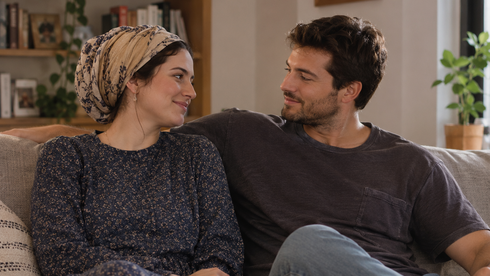
“On our first Yom Kippur together, when he didn’t go to synagogue, I realized he wasn’t the religious man I thought I had married,” says Noa, 28, from Haifa.
She woke early to pray.
Her husband, Yehezkel, remained asleep.
When she returned home during the afternoon break, he was still in bed, and she found herself urging him to at least attend the Kol Nidrei service that evening.
“A religious person doesn’t behave like that on Yom Kippur,” she says.
“From then on, I had all kinds of fears, and they turned out to be justified.” Noa, whose name has been changed, had discovered that her husband was gradually leaving religious observance without having told her.
The couple met five years ago through a matchmaker.
They dated for three months before becoming engaged, a relatively long courtship in the ultra-Orthodox world in which they moved.
“Our first date was really good,” Noa says.
“There was a strong connection and the conversation flowed.
We didn’t talk much about religion, even though I knew it was important to make sure we both wanted to build a home based on shared Jewish values.” Noa grew up in an ultra-Orthodox home.
Yehezkel had once been Hasidic before moving toward a more modern ultra-Orthodox lifestyle, and as a couple they initially imagined themselves moving toward the religious-Zionist world.
“When we were dating, he put on tefillin and got up in the morning to pray with a minyan,” she says.
“After we married, many religious differences emerged.” Yehezkel says the warning signs were already there.
“Early in the marriage, we were already having conversations about questions of faith,” he says.
“I told her I was angry with God for putting me through many difficulties in life, and I didn’t understand why.
It was very hard for Noa to hear, but the penny really dropped for her on our first Yom Kippur together.” “I stayed home most of the day and only went to synagogue in the evening, and even then because I didn’t want to disappoint her,” he says.
“Later she saw that on Shabbat I wasn’t regularly going to synagogue either, because I had begun loosening my observance.
Once she understood that, it created a crisis of trust in our relationship.” ‘Suddenly I realized the ground beneath me wasn’t stable’ Noa says the revelation devastated her.
“I took it very hard and didn’t speak to him for an entire week,” she says.
“I was so shocked and hurt that I wanted to run away and live on my own.
It was the hardest week of my life because suddenly I realized I was standing on unstable ground.” Her rabbi and bridal counselor told her she had to decide whether to leave or stay.
“But they told me that if I chose to stay, I had to accept who he was and understand that every person has a different reality,” she says.
Yehezkel initially promised that the change was temporary.
“I told her I wanted to be religious, that I would improve and stop violating Shabbat, and I really did try,” he says.
“I tried to convince both of us that it was a temporary crisis and that it would pass.
But it didn’t.” Noa began emotional therapy.
Yehezkel says he mostly withdrew into himself.
Two years later, they were referred to Hitkashrut, an organization that helps families dealing with religious differences between spouses.
Eventually, Yehezkel formally left religious life.
Noa chose to remain in the marriage.
“It was difficult, but I tried to be supportive and not show how shocked I was,” she says.
“It is still hard, especially on Shabbat and holidays, because our lifestyles are different.” “On Shabbat, it is hard for me to be alone at home, and it is hard for him to go out alone, but we still manage to enjoy being together.
We have the meal together and sing Shabbat songs in the living room.
When he wants to use his phone, he respects me, goes into another room and closes the door.” “Sometimes I complain, but in the end, what do I really want? I just want him to be with me.” ‘I’ll knock before I come in’ Yom Kippur makes those differences particularly stark.
“We’ll sleep in separate rooms because of the prohibition on marital relations, and I don’t know what he’ll do in his room in terms of screens,” Noa says.
“I’ll be in synagogue most of the day.” “When I come home, I’ll knock on the door so he can let me in.
I won’t take a key, because I want to give him advance warning so I don’t see him eating.” They will still eat the pre-fast meal together, and Noa says she continues trying to persuade him to attend Kol Nidrei.
“He does help me observe my commandments,” she says.
“He wakes me up for synagogue and buys the Four Species for me to make me happy.” She expects the religious gap to become more complicated if they have children.
“We’ll have to work things out and agree in advance on how we do things,” she says.
“But right now we’re in a healthy place.
We have open communication, we say what we feel and think, we focus on the good things and we’re not frightened by our differences, because anything can be bridged if there is love and goodwill.” ‘A change in faith is not only an individual process’ Avital Baram, a social worker and couples therapist who co-founded Hitkashrut Zugiyit, says a change in religious identity can shake the foundations of a marriage when both partners originally entered it with the same level of observance.
“The spouse can experience it as a betrayal, because these were not the circumstances under which they committed to the relationship,” she says.....