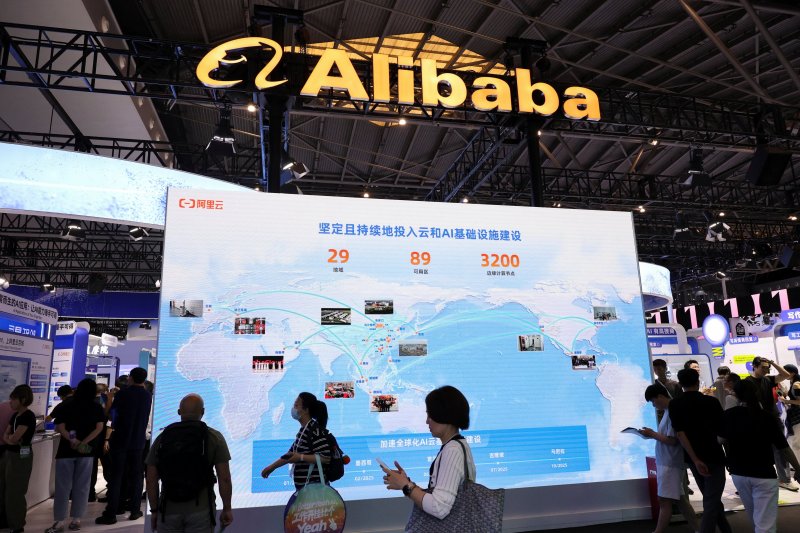
The announcement signals a significant escalation in the technological rivalry not only within China but across the global digital economy.
The new model is positioned as a high performance, large scale system capable of handling complex language, reasoning, and multimodal tasks.
It reflects Alibaba’s ambition to move beyond its traditional dominance in e commerce and cloud computing into the core frontier of artificial intelligence innovation.
This development matters because AI models are increasingly becoming foundational infrastructure for modern economies.
From enterprise automation to consumer applications, the ability to build and deploy powerful AI systems is now seen as a strategic capability on par with energy or telecommunications.
What exactly is the new AI model and what can it do? Alibaba’s new AI system belongs to the category of large language models, often referred to as LLMs.
These models are trained on vast datasets and can perform a wide range of tasks, including text generation, translation, coding assistance, data analysis, and conversational interaction.
Beyond basic language tasks, the model is designed to integrate multimodal capabilities.
This means it can process and generate not only text but also images, and potentially video or audio.
Such functionality positions it as a versatile tool for both enterprise clients and consumer facing applications.
The model reportedly emphasizes improved reasoning ability and contextual understanding.
This is a key differentiator in the current AI race, where companies are striving to build systems that can move beyond simple pattern recognition toward more sophisticated problem solving.
How does this move position Alibaba against Tencent? The rivalry between Alibaba and Tencent has traditionally played out across sectors such as digital payments, social media, gaming, and cloud services.
However, artificial intelligence has become the new battleground.
Tencent has invested heavily in AI, integrating it into its vast ecosystem that includes messaging platforms, gaming networks, and enterprise solutions.
Alibaba’s new model is a direct attempt to counter this influence by strengthening its own AI infrastructure and embedding it across its services.
While Tencent benefits from its dominance in user engagement through platforms like messaging and entertainment, Alibaba’s advantage lies in its deep integration with commerce and logistics.
The introduction of a powerful AI model allows Alibaba to enhance everything from supply chain optimization to personalized shopping experiences.
This dynamic suggests that AI is not just a standalone product but a force multiplier across existing digital ecosystems.
Why is China’s AI competition intensifying now? The intensification of AI competition within China is driven by several structural factors.
First, the Chinese government has identified artificial intelligence as a strategic priority, encouraging domestic companies to accelerate innovation and reduce reliance on foreign technologies.
Second, the global AI race has entered a phase where scale and speed matter more than ever.
Companies that fail to keep up risk being locked out of future technological ecosystems.
Third, the commercial applications of AI are expanding rapidly.
From finance and healthcare to manufacturing and education, AI is becoming a core driver of productivity and competitiveness.
In this context, Alibaba’s move can be seen as both defensive and offensive.
It is defending its market position while also seeking to capture new opportunities in emerging sectors.
How does this affect the global AI race? Alibaba’s new model has implications far beyond China.
The global AI race is increasingly shaped by competition between major technology hubs, including the United States, China, and to a lesser extent, Europe.
By introducing a competitive AI system, Alibaba contributes to a more multipolar technological landscape.
This could lead to greater fragmentation in AI ecosystems, with different regions developing their own standards, platforms, and regulatory frameworks.
At the same time, it increases the pace of innovation.
As companies compete to outperform each other, they invest more heavily in research and development, leading to rapid advancements in AI capabilities.
However, this competition also raises concerns about governance, ethics, and security.
The deployment of powerful AI systems requires careful oversight to ensure they are used responsibly.
What role does Alibaba Cloud play in this strategy? Alibaba Cloud is central to the company’s AI ambitions.
As one of the largest cloud service providers in Asia, it offers the infrastructure needed to train, deploy, and scale AI models.
The integration of the....