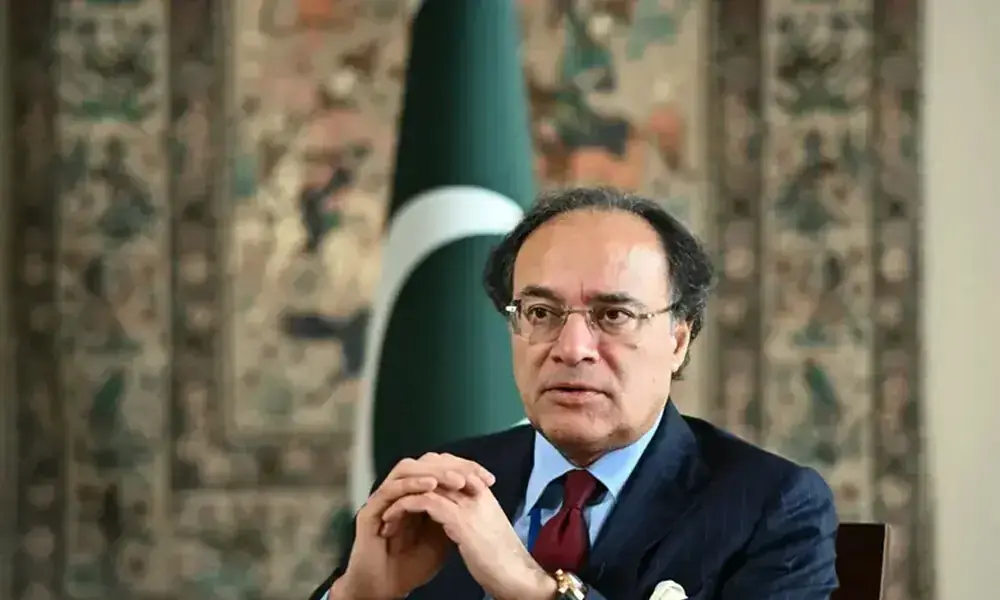
ISLAMABAD: Pakistan needs financial innovation that lowers the cost of doing business and brings more people into the formal economy as the country moves from economic stabilisation towards sustainable growth, Finance Minister Muhammad Aurangzeb said.
Virtually addressing the “Dialogue on Digital Assets and the Future of Banking,” organised by the Pakistan Banks’ Association (PBA) in collaboration with LUMS on Monday, Aurangzeb stressed that the integration of digital assets into the financial system should be guided by practical economic benefits and their ability to facilitate business operations.
Aurangzeb said Pakistan’s economic progress requires continued fiscal discipline, higher exports and greater private-sector investment.
READ ALSO: Pakistan explores tokenisation of existing Eurobond debt, says Aurangzeb He highlighted the use of deposit tokens for institutional clients on blockchain networks as a practical example of digital financial innovation, explaining that such developments could help improve financial operations.
Senator Aurangzeb said the government is holding discussions on the proposed initiative and is seeking Cabinet approval before proceeding with the issuance of a request for proposals (RFP).
“We are reviewing at this point from the Ministry of Finance and Government of Pakistan, is tokenization of our existing Eurobond debt.
We are in discussions at this point, and we are looking forward to the Cabinet approval on this, before we move ahead with issuing the RFP on this front,” he added.
The finance minister also referred to the Bank for International Settlements’ (BIS) Project Agora, which is examining tokenised bank deposits and exploring the potential for cross-border payments using central bank reserves.
The finance minister emphasised that banks remain central to protecting customers’ funds and reducing risks associated with digital technologies.
He said banks also have a fundamental role in delivering financial services to consumers, making their involvement important as digital assets become part of the financial system.
Aurangzeb noted that risks linked to stablecoins depend on their issuers and the mechanisms through which they are backed and redeemed.
He added that the risks associated with unbacked crypto assets vary.
Aurangzeb said Pakistan has made progress towards developing a legal and supervisory regime for virtual assets, with the Virtual Assets Act 2026 providing the country’s legal framework.
Under the law, the relevant authority is responsible for licensing and supervising virtual asset service providers.
He stressed that regulations must distinguish between different categories of digital assets and the economic activities associated with them, rather than applying a single approach to the entire sector.
The finance minister identified the State Bank of Pakistan (SBP) and the Securities and Exchange Commission of Pakistan (SECP) as key institutions in shaping the regulatory framework for digital assets.
He said effective oversight is essential to ensure that innovation supports economic activity while addressing the different risks posed by stablecoins, other virtual assets and unbacked cryptocurrencies.
The finance minister urged banks to play an active role in developing practical proposals around digital financial technologies.