As one of the biggest targets of wartime looting in centuries past, China is now positioning itself as a global pioneer in repatriating lost cultural artefacts.
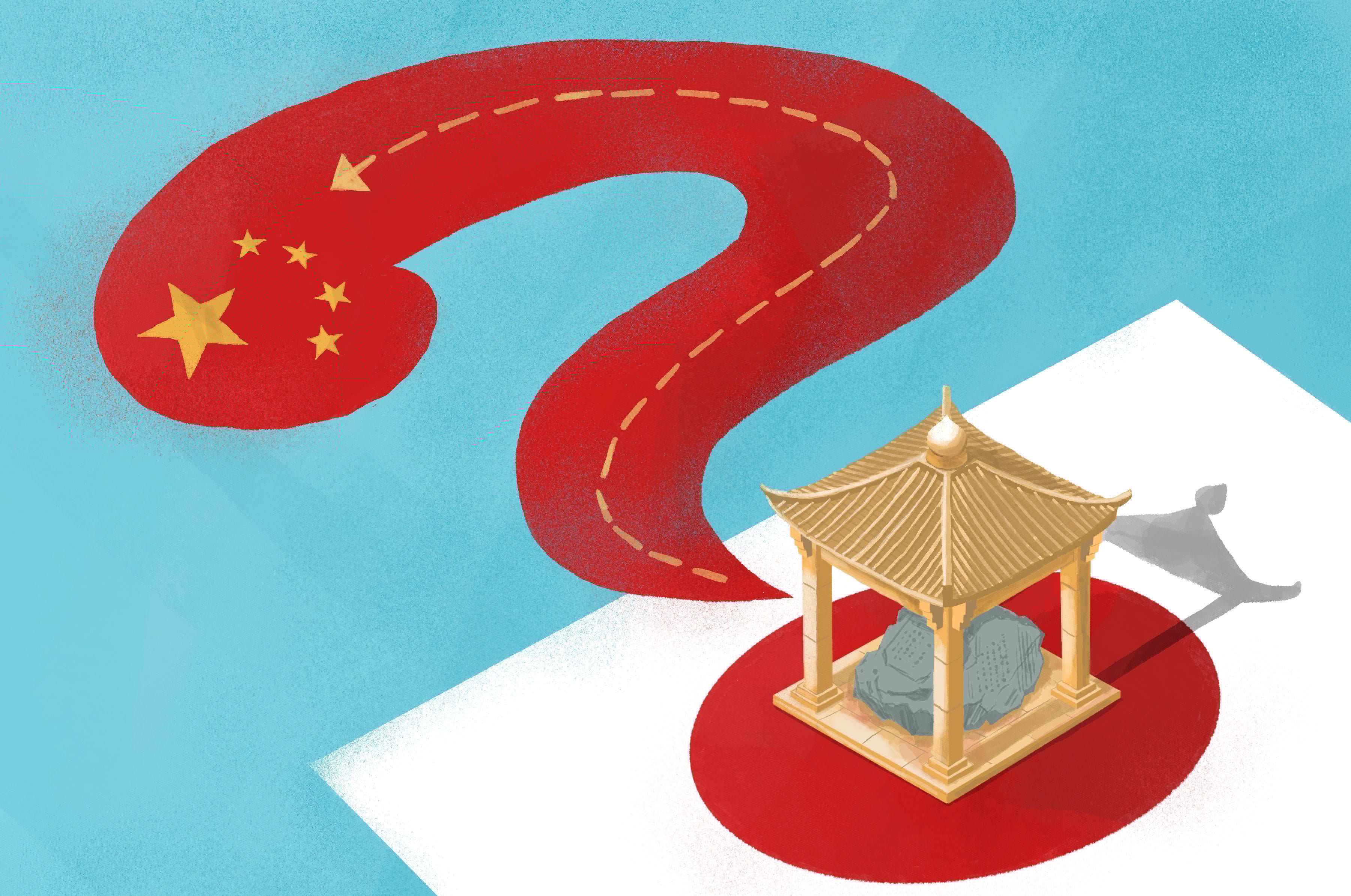
This article, the first in a two-part series, Xinlu Liang looks at whether a stolen 1,300-year-old Chinese stone now housed in Japan’s Imperial Palace can become a test case for a reckoning over wartime plunder.
In 1945, following Japan’s surrender to the Allies, supreme commander General Douglas MacArthur ordered the country to return looted cultural treasures to their rightful nations across Asia.
However, the directive was limited: it applied only to items seized after the 1937 Marco Polo Bridge incident, ignoring earlier plunder during the first Sino-Japanese and Russo-Japanese wars.
The bureaucratic process was also complex, requiring detailed records of each theft – documentation that many war-ravaged nations could not provide.
By the late 1940s, China had compiled a list of more than 150,000 books and 2,000 artefacts – a figure researchers later deemed to be an underestimate.
For 80 years, except for a trickle of relics handed over to the defeated Kuomintang in Taiwan in the 1950s, the vast majority of China’s stolen heritage remained in Japan, with some 2 million Chinese items scattered across various museums.
But this could soon change.
Chinese and Japanese researchers and civic groups have been demanding that Japan return a Tang dynasty (618-907) stele, or stone tablet, held in Tokyo’s Imperial Palace for over a century.
Activists and observers view this as the opening move in a campaign to make the return of a single artefact a template for broader restitution efforts.
In doing so, the goal is to break down long-standing barriers to the return of countless other relics.
This case will test whether a new model – built on solid academic evidence, transnational civil society and diplomatic pressure – can succeed where post-war mechanisms failed, they say.
It could also be a test of diplomatic relations between the two countries.
Erected in AD714 in present-day Lushun, in the northeastern province of Liaoning, the Tang Honglu Well Stele has a 29-character inscription that commemorates a Tang envoy’s visit to the Bohai Kingdom, a neighbouring state to the northeast.
It bestows a formal title on the Bohai ruler, and is the foundation for China’s claims to sovereignty over the territory.
In 1908, following Japan’s victory in the Russo-Japanese war and seizure of Lushun from Russia, which had occupied the port city since 1897, the Japanese navy dismantled and shipped the stele to Tokyo’s Imperial Palace as a “war trophy” – just one of millions of Chinese artefacts, from Buddhist statues to imperial library collections, looted during wartime.
Since then, Japan has regarded the stele as Japanese “state property”.
The first public challenge emerged in the 1990s, driven by researchers and a brash activist.
At the time, China and Japan were still in a diplomatic and economic honeymoon.
The two countries had normalised relations in 1972, with Beijing waiving its right to formal war reparations.
Nevertheless, in 1992, during Emperor Akihito’s historic visit to China – the first of its kind – activist Tong Zeng called publicly for the return of Chinese relics.
Tong, who later founded the China Federation of Demanding Compensation from Japan, sparked high-level interest in Beijing in the case.
The office of Jiang Zemin, then general secretary of the Communist Party, asked Tong to give Jiang a list of artefacts that could be presented at a state banquet, according to Meng Huizhong, the federation’s vice-president.
“Tong said there were a lot, but couldn’t provide a list, so the moment passed,” Meng said.
“But he repeatedly firmly opposed paying high prices to buy back the things Japan stole from us, saying doing so would be an insult to the Chinese people.” After that, researchers including Wang Renfu at Baicheng Normal University began to pore over historical texts to confirm the stele’s origin and significance, transforming it from an obscure artefact into a symbol of lost heritage.
In the 2000s, research associations showed an interest in the tablet, and high-level Chinese-Japanese academic collaborations took shape.
Advocacy also spread to civil society groups.
Yet China refrained from openly demanding the stele’s return, according to Cui Baojuan, who has led the federation’s repatriation efforts since 2017.
The incomplete nature of wartime looting records had further complicated recovery efforts, making many artefacts difficult to trace, especially as Japan had “never fully atoned for its wartime crimes”, said Huo Zhengxin, a professor of international law at the China University of Political Science and Law, and an observer to the 1970 Unesco Convention on Prohibiting and Preventing the Illicit Import, Export and Transfer of Ownership of Cultural Property.
In 2014, on the 1,300th anniversary of the stele’s creation, Wang joined forces with the federation, which took a bold step by petitioning Japan directly for its return – “the first time a Chinese group formally requested the artefact from Japan’s monarchy”, Cui said.
To do this, Wang Jinsi from the federation’s department of cultural relics repatriation went to Tokyo to make an appeal.
Before departing, China’s National Cultural Heritage Administration offered some guidance.
“They told us that, as a state department, they couldn’t take the lead,” Meng said.
“They said, ‘You folks in civil society go ahead and push.
Keep pushing it forward bit by bit.
When the time is ripe, we can step in.’” Wang Jinsi decided to visit on December 23, Emperor Akihito’s birthday, when the Japanese Imperial Palace is open to visitors and draws large crowds.
“Our Chinese relic is 1,300 years old but we’ve never had the chance to celebrate [the anniversary].
So I wanted to use that moment to challenge [Japan],” he said.
“I even scouted the moat and considered jumping the wall to create a diplomatic incident if talks went nowhere.” With police monitoring the group, Wang Jinsi could not confront the imperial family but did manage to deliver restitution request letters to palace officials and later Japan’s foreign ministry, which accepted them but never formally replied.
Other civic groups have made appeals for other relics.
In 2015, Wu Xianbin, director of the Nanjing Folk Anti-Japanese War Museum, led a delegation to Miyazaki in southern Japan to demand – unsuccessfully – the return of 238 Chinese stones embedded in the Hakko Ichiu tower, a monument to imperial conquest that was renamed the Tower of Peace.
Both campaigns drew wide coverage in Chinese and Japanese media, but their direct petitions were not successful.
Niu Mengchen, a researcher at Shanghai University’s....