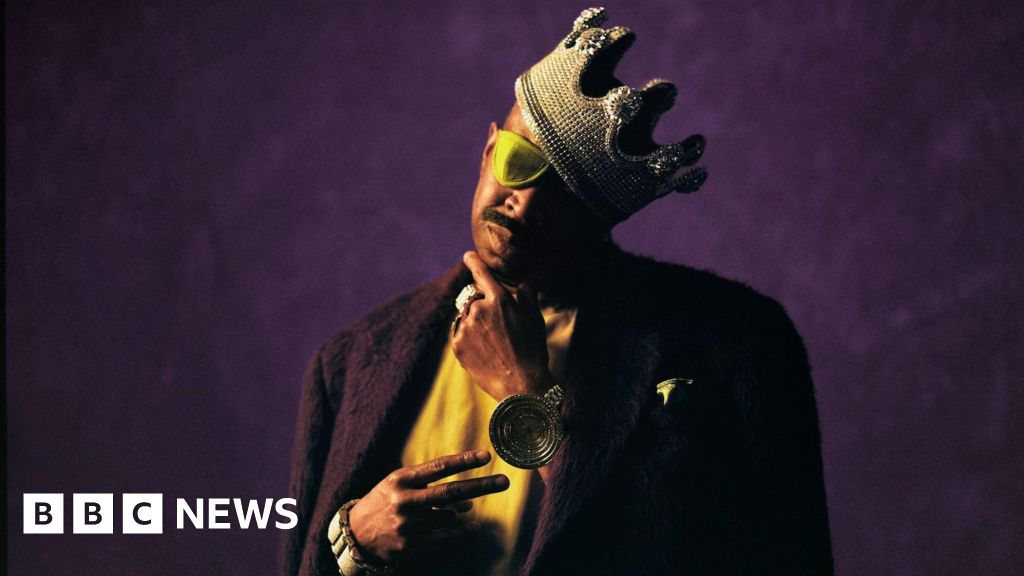
Rap legend Slick Rick on Mobo honour and shaping hip-hop: 'We took novels to the next level' If hip-hop is the folk music of the post-industrial age, then Slick Rick is it's Woody Guthrie.
Born in London and raised in the Bronx, the rapper essentially invented the smooth-talking storytelling style that has inspired everyone from De La Soul and Digital Underground to Snoop Dogg and Kendrick Lamar.
His witty, thoughtful verses broadened the scope of hip-hop with stories about treating your mother with respect and catching your girlfriend cheating with the postman, alongside hard-hitting lyrics about social deprivation and immigration.
Eminem described himself as "a product of Slick Rick", Jay-Z likened the star to Matisse, and Questlove called his voice "the most beautiful thing to happen to hip-hop culture".
Amy Winehouse immortalised him in the song Me and Mr Jones.
On Thursday, he will receive a lifetime achievement prize at the Mobo Awards after performing a career-spanning set with Estelle.
Speaking from his home in New York, Slick Rick is remarkably humble about the honour.
"That feels great, the appreciation," he says.
"Thank you, England." Born to Jamaican parents in Mitcham, south London, in 1965, Ricky Walters was blinded in one eye by broken glass as an infant and took to wearing an eye patch.
He emigrated with his family to the Bronx in 1976, when he was 11 years old.
But New York was a different city then.
Gripped by a financial crisis, drugs and crime were rife.
The infrastructure was crumbling and travelling alone was unwise.
"If you were poor and coming up, you were pretty much [stuck]," says Rick.
His family moved in with his grandmother, squeezing into a cramped apartment full of aunts, uncles and cousins.
"It reminds me of the beginning of Willy Wonka and the Chocolate Factory, where he has two sets of grandparents all in one bed," he says.
"We still had fun but when you look back, you say, 'Wow, that was a lot of us on one mattress.'" By chance, however, he'd ended up in the birthplace of hip-hop, right at the moment of conception.
"People would bring out sound systems and set them up in the parks," he recalls.
"It drew the youth because it made you dance and have fun.
I was hooked instantly." Attending LaGuardia High School of Music & Art, he became friends with future rapper Dana Dane and they started writing their own rhymes.
"We didn't have instruments or nothing.
We just banged on the desk.
And every other day, we would write a rap to try and impress each other." Performing as the Kangol Crew, Rick played up his English heritage - wearing regal capes and ostentatious jewellery, while referring to himself as Rick the Ruler or Richard of Nottingham.
His unique delivery – conversational and charismatic, combining Jamaican intonation with witty Britishisms and elevated vocabulary – was already in place.
It's a style he developed in the hustle and bustle of his busy Bronx home.
"As a kid, I'd tell stories and jokes in front of my uncles and aunts and see the effect on them.
I was just having fun, I don't know how to explain any better than that." That flow ultimately earned him the name Slick Rick, bestowed by legendary hip-hop producer Doug E Fresh, who spotted him at an open mic night and invited him to join his Get Fresh Crew.
In 1985, they made history with the songs The Show and La-Di-da-Di, the "greatest two-sided single since Hound Dog/Love Me Tender", as critic Peter Shapiro later wrote in The Rough Guide to Hip-Hop.
Rick downplays that, describing the songs simply as the sound of two friends "playing around" and "having fun".
The Show was....