The great sociologist André Béteille, who died recently, once wrote to me saying: “You must meditate a little more on the place of evil in the conduct of human affairs.” He thought that I focused too much on writing about politicians of goodwill, such as Gandhi.
But history was made, and unmade, as much – and often even more – by people of malign intentions.
I recalled Professor Béteille’s warning when the present conflict in West Asia broke out.
This conflict posits the United States of America and Israel on one side against Iran on the other.
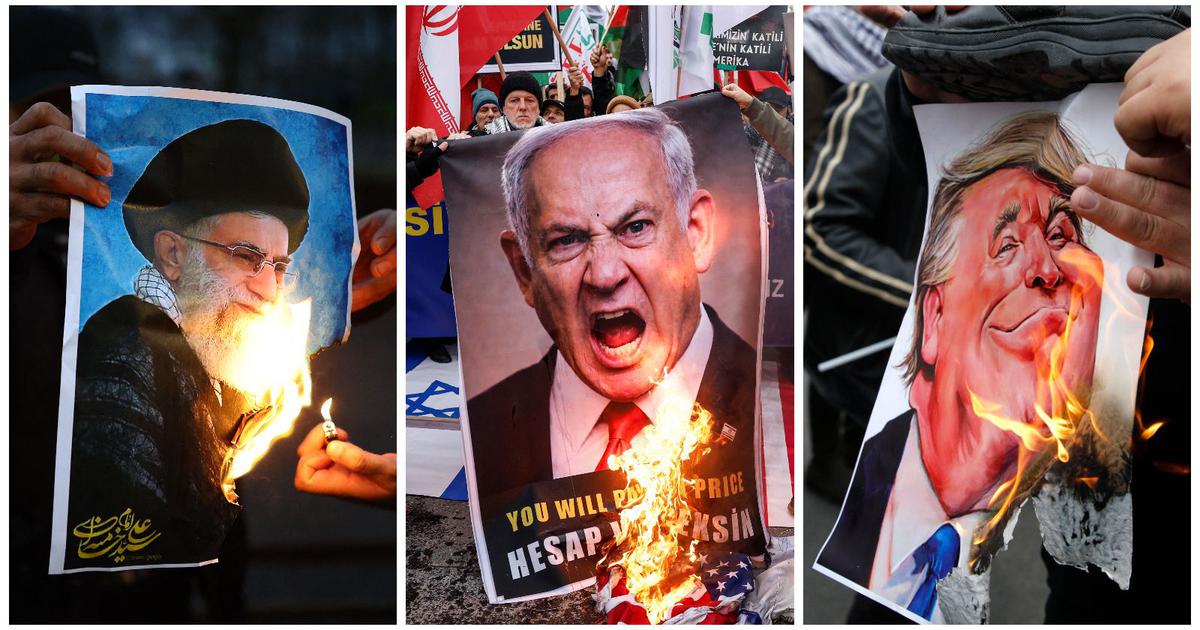
But crucial to how the war has unfolded are the personalities of the three men who have led, or are still leading, these countries.
Let us begin with the leader who is no longer alive, the late Ali Khamenei.
Khamenei undoubtedly exhibited bravery in refusing to hide when the bombs began to fall, willingly embracing death.
The courage he showed in his last days – when juxtaposed with the brute force and perfidy of his enemies – has led some left-wing intellectuals to portray him as an anti-imperialist icon.
This seems to me simplistic in the extreme.
The manner of his death should not allow us to obscure the manner of his life, and, above all, how he exercised power in Iran when he was alive.
As Supreme Leader of Iran, Khamenei had three choices.
The first was to respond to the democratic aspirations of his people by gradually withdrawing the clergy from the political process and fostering a freer society.
This path would – or should – also have emphasised gender equality by removing the oppressive dress codes imposed on Iranian women, and otherwise enabling them to play a full part in the country’s economic, social, and political life.
Like Gulf countries such as Oman, Qatar and (above all) Saudi Arabia, Iran has significant reserves of oil.
Unlike them, it has a highly educated population, with a history of entrepreneurship, scientific research and – prior to the Islamic Revolution of 1979 – an active role of women in the educational and professional sectors.
Iran also has a far richer cultural history than the Gulf countries, having produced great philosophers, poets, and musicians down the centuries.
Khamenei was fully aware of this history and could have leveraged it to build a prosperous and self-reliant Iran.
Democracy with economic growth was the first path the late Ali Khameini could have fostered in his long years in power.
Economic growth without democracy (on the Singapore model) was a second path available to him.
Instead, the Iranian regime under his leadership chose a third path, of increased repression at home and reckless expansionism abroad.
Its sponsorship of armed groups in Lebanon and Yemen, and its military support to the brutal regime of Bashar al-Assad in Syria, played a critical role in tearing those countries apart.
Iran under Khamenei hubristically set itself up as the leader of the Islamic world, displaying a particular animus towards the Jewish State of Israel, which it has regularly attacked through its proxy, Hezbollah.
For decades now, the cry of :Death to Israel” has been as common as “Death to America” in pro-regime rallies in Tehran.
Come next to Israel, whose long-time leader, Benjamin Netanyahu, is as fanatical an ideologue as Khamenei was, and arguably even more cold-blooded.
Netanyahu’s hardline Zionism comes from his family background – his father was a celebrated right-wing Jewish historian, and his brother an army officer who died in 1976 seeking to rescue Israelis held hostage by terrorists in Entebbe airport.
In his many years as prime minister, Netanyahu has systematically undermined any prospect of Palestinian statehood by overseeing a massive expansion of illegal settlements in the West Bank.
His hatred of the Palestinian Authority was so visceral that at one stage he even sponsored Hamas to undermine them.
Then, after the terror attack by....