Iran and the Economy: The Danger Isn’t the Shock.
It’s the Duration.
Randolph Bourne said war is the health of the state.
Then let’s say the other part out loud: war is a disease in the economy.
That is the real economic question hanging over the Trump administration’s war on Iran.
A short, bounded conflict can be absorbed.
A prolonged one doesn’t just raise the odds of a recession.
It can lower the economy’s speed limit by diverting real resources, depressing investment, and extending a politics of permanent emergency.
We’ve seen that movie.
We even gave the middle act a name: secular stagnation.
War Costs Don’t End with the Price of Oil The first thing markets do in a Persian Gulf war is stare at crude oil prices.
Energy is still the quickest way geopolitics shows up in household budgets and corporate margins.
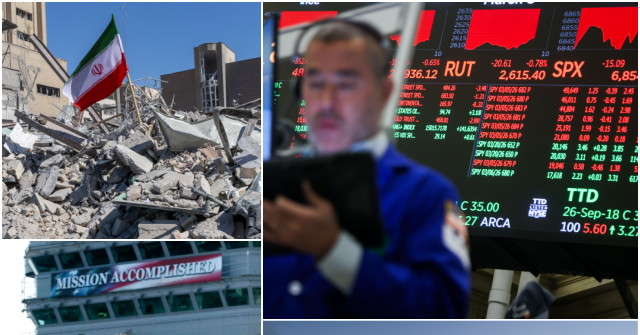
This week, we saw a dynamic daily: when oil surged, stocks plunged.
When oil prices eased, stocks rose.
But oil is only the most visible channel.
The deeper channel is the one that doesn’t come with a flashing price screen or a ticker running across financial television: the diversion of real resources.
War pulls scarce inputs—high-skill labor, industrial capacity, managerial attention—into the war apparatus and its domestic support ecosystem: procurement, intelligence, logistics, contracting, compliance, security, and the “temporary” architecture that has a habit of becoming permanent.
Keynes put the essence of this in a sentence that ought to be printed on every war appropriation: “Every use of our resources is at the expense of an alternative use.” In wartime, he wrote, the “cake” is effectively fixed: if we fight better, we don’t get to eat more.
That is the part of war economics that gets lost when we talk only about the budget line.
War doesn’t merely spend money.
It redirects the country’s scarce capacity, and the civilian economy becomes smaller than it otherwise would have been because the “alternative use” never happens.
Milton Friedman, from a very different tradition, reinforces the same core point from another angle.
He argued that inflation is not an inevitable consequence of war; it depends on how the war is financed.
That’s useful because it separates two questions people constantly confuse.
A country can finance war without an immediate inflation blowout.
But it still pays the basic price Keynes described: foregone civilian output and foregone investment.
Even when the CPI behaves, the opportunity cost is real.
The Economics in One Unglamorous Number If war spending reliably made the economy richer, you’d expect defense outlays to generate big multipliers.
But the economic research points the other way.
Robert Barro, the Harvard economist best known for work on growth and fiscal policy, and Charles Redlick tried to answer a simple question with hard data: when Washington ramps up defense spending, how much extra economic output do we actually get? They measure what economists call the “multiplier”—the ratio of the change in GDP to the change in government spending.
If the multiplier is one, a dollar of defense spending adds roughly a dollar to GDP.
If it’s less than one, the government is buying real stuff—labor, steel, fuel, factory capacity—but total output rises by less than the amount spent because other activity is being pushed aside.
Barro and Redlick’s estimates for temporary defense spending come in well below one: roughly 0.4 to 0.5 on impact and still below one over a couple of years.
That is a polite academic way of saying war spending displaces civilian production, and what tends to get displaced is precisely what you’d least like to sacrifice if you care about living standards five years from now: private investment.
That’s the heart of the long-war danger.
The economy can look busy while quietly investing less in the machinery, infrastructure, and innovation that raise productivity.
This is “crowding out” without the interest-rate morality play.
Interest rates can stay low, and you can still get crowded out in the only sense that ultimately matters.
Real resources are finite.
Distortion Is the Rule, Not the Exception If you want to see what “diverted production” looks like when it’s real, you don’t need economic theory.