A joint U.S.-Israeli attack on Iran, followed by Iranian retaliation against U.S.
military assets, Israel and other U.S.
allies, has engulfed much of the Middle East in conflict.
Crisis Group experts offer a 360-degree view of the new war’s initial reverberations in the region.
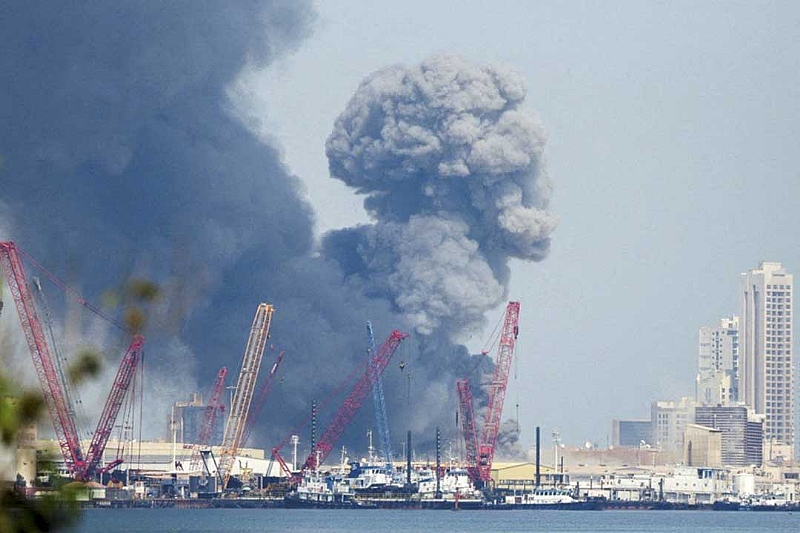
A mounting multi-front war has exploded in the Middle East, with more than a dozen countries either party to the conflict or caught up in it.
On 28 February, Israel and the United States joined in launching massive airstrikes on Iran, hitting government offices and military installations, among other sites.
The campaign’s immediate aim was to decapitate the Islamic Republic’s leadership, and it quickly achieved this goal.
An early Israeli missile smashed into a Tehran building, killing the regime’s supreme leader, Ayatollah Ali Khamenei, along with several other senior government and military officials.
But the broader objectives of the operation, which the U.S.
has dubbed Epic Fury and Israel calls Roaring Lion, remain clouded in uncertainty.
and Israeli officials have spoken, among other things, about ending Iran’s nuclear program, eliminating its missile stockpiles, sapping its naval power and “creating conditions” for the regime’s demise.
What might be enough for them to declare victory is unclear.
In the meantime, conflict has engulfed much of the region.
Iran had warned that, if attacked, it would take the fight to U.S.
security partners, assets and personnel in the region, and it made good on the threat.
It struck back immediately, unleashing barrages of missiles and armed drones at U.S.
bases in Bahrain, Kuwait, Oman, Qatar, Saudi Arabia and the United Arab Emirates, as well as at Israel.
Its drones have struck the U.S.
embassies in Riyadh and Kuwait City.
In subsequent days, it also fired at U.S.
bases in Iraq, Jordan and Türkiye, along with a British base in Cyprus.
Two of its drones have landed in Azerbaijan.
This retaliation has been broader in scope than many expected, encompassing military and civilian infrastructure belonging to the Gulf Arab states.
Hizbollah, formerly the strongest non-state actor in the “axis of resistance”, which Tehran has nurtured as part of its “forward defence” strategy, has fired salvoes at Israel, triggering a withering Israeli response including ominous warnings for civilians to evacuate southern Lebanon and swathes of the capital Beirut.
On 5 March, Israel sent ground forces into the south and commenced heavy bombing of Beirut’s southern suburbs.
In Iraq, Iran-backed groups have launched rockets at U.S.
bases and diplomatic installations in both Iraq and neighboring countries, including Saudi Arabia.
It is unclear what Tehran has in mind for its allies the Houthi rebels in Yemen, who appear to be laying low for the time being.
The conflict’s toll has already been steep.
As of 6 March, Iranian authorities said more than 1,300 people had been killed in Iran, including at least 150 children at an elementary school in the southern city of Minab.
At least 80 Iranian sailors died when a U.S.
submarine sank an Iranian frigate off the coast of Sri Lanka.
Iranian missile strikes have killed eleven Israelis.
military personnel number among the dead, killed by an Iranian drone hitting their garrison in Kuwait.
At least nine people have been killed in the Gulf Arab countries so far, and more than 200 in Lebanon.
The war is also doing tremendous economic damage, for instance stifling oil and gas exports through the Strait of Hormuz.
and Israel have offered a shifting set of rationales for setting off this firestorm.
and Israel have offered a shifting set of rationales for setting off this firestorm.
Early in the year, President Donald Trump threatened intervention to protect the protesters who had massed in Iran’s streets from a brutal regime crackdown.
Though the regime did not stand down thereafter, and may indeed have repressed the dissent with greater energy, Trump stayed his hand, likely out of concern that U.S.
forces in the Middle East were not postured to protect U.S.
interests there should fighting escalate.
As he sought to remedy that situation by sending an armada into the region, the U.S.
focus shifted from humanitarian to nuclear concerns, with Trump repeatedly voicing his determination that the Islamic Republic never be allowed to acquire a nuclear weapon.
He left the door open for a diplomatic settlement, however, and throughout February, even as it flooded the Middle East with military assets, the U.S.
engaged in talks with Tehran, reportedly securing concessions that were unprecedented, if still less than satisfactory to the White House.
Israel, for its part, seems to have been primarily concerned with Iran’s ballistic missile program, which the Islamic Republic had been rehabilitating since the twelve-day war of June 2025.
On 2 March, Trump hinted at similar concerns, suggesting (implausibly, if U.S.
intelligence agencies are to be believed) that Iran might “soon” have projectiles that could reach the continental U.S.
Nor did clarity on the rationale emerge after the war began.
Jaws dropped worldwide when Secretary of State Marco Rubio offered yet another justification for U.S.
action: that Israel was set on attacking Iran, and the U.S.
knew Iran would respond with fire at U.S.
bases, meaning that Washington had to strike first.
But this effort at advancing a self-defence logic, which the White House might have hoped would explain its failure to seek authorisation from Congress for Epic Fury, was so transparently circular that administration officials have struggled to stick with it.
Still, despite confusion about U.S.-Israeli motives, and the seeming lack of an international law justification for starting the war, Washington has faced little meaningful pushback from its European allies, who continue to walk on eggshells for fear that the U.S.
will cut off remaining support for Ukraine and pull back from its security commitments to the continent.
While some (notably Norway, Sweden and Spain) have questioned the international legal basis for bombarding Iran, many leaders – including Kaja Kallas, the European Union’s chief representative for foreign policy – have directed their primary admonitions at Tehran for its indiscriminate attacks on Gulf Arab countries.
This criticism is more than fair, as Iran has trained its sights on both military and civilian targets, but to focus on the reaction to the exclusion of the original transgression that plunged the Middle East into mayhem rather misses the point.
(Some also argue that acquiescence in the U.S.-Israeli campaign against Iran undermines Europe’s stance against Russia’s war of aggression in Ukraine.) As the first week of this new war in the Middle East draws to a close, and the world wonders anxiously how much longer it will go on, the fundamental question is what winning means for the United States.
The early conversations defaulted to mathematics and guesswork: who will run out of interceptors or launchers first, for instance, or whether a catastrophic hit would shake the Trump administration’s commitment to the fighting.
These are important questions, but they do not elucidate a theory of victory.
Without one, the conflict could too easily settle into a grinding cycle of degradation, endurance and reconstitution.
Breaking it would likely require one of a handful of outcomes: destroying Iran’s capabilities and deterring its rulers from reconstituting them; negotiating a deal that all parties adhere to; or ushering in a new regime in Tehran that takes fundamentally different course.
It is not clear which of these endgames Washington is pursuing.
On the morning of 6 March, Trump indicated a preference for the third, posting on social media that “there will be no deal with Iran except UNCONDITIONAL SURRENDER! After that, and the selection of a GREAT & ACCEPTABLE Leader(s) … we will work tirelessly to bring Iran back from the brink of destruction”.
The stage thus seems set for a protracted showdown.
The war may yet produce upheavals inside Iran – mass unrest, a military takeover or fragmentation along ethnic lines – but these scenarios are as likely to yield prolonged chaos or a hardened successor regime as they are to deliver a more conciliatory Iran.
They are contingencies, not objectives per se, and banking on them is its own form of strategic incoherence.
Absent the emergence of clearer thinking, it may take a war-induced economic shock to force a reckoning before the military logic plays out: oil price spikes, paralysed shipping lanes and the buckling of the Gulf’s expatriate-driven economic model could produce costs that neither Washington nor its partners will be willing to sustain indefinitely.
In this 360-degree survey, Crisis Group experts offer their assessment of the war’s initial consequences for both the countries doing the firing and those in the line of fire.
IranFor the Islamic Republic, the launch of U.S.
and Israeli strikes posed two immediate challenges: maintaining cohesion at the top of the system and mounting a response despite being, once more, caught in a fight with conventionally superior forces.
The death of Supreme Leader Khamenei was a contingency the Iranian regime had long anticipated – if not under fire, then due to advancing age.
It quickly put the wheels of succession in motion, appointing a transitional council composed of the heads of the executive and judicial branches, along with a member of the Guardian Council, the powerful clerical body that wields a veto over legislation and candidates for election, until a permanent replacement for Khamenei can be confirmed.
But, for the time being, the exigencies of war and regime survival will be paramount.
Succession deliberations, with all their formal trappings, are proceeding amid the emergency of continued U.S.-Israeli attacks, which aside from military facilities have hit both political figures and state forces tasked with defending the system from domestic dissent.
Thus, while the designation of a new Supreme Leader will give an important signal as to what direction the regime intends to take – continuity in the mold of a Khamenei acolyte or, less likely, a shift toward a less dogmatic character – other figures like Ali Larijani, the secretary of the Supreme National Security Council, who has strong ties to the Revolutionary Guards, appear poised to exercise great influence over decision-making.
Meanwhile, having violently suppressed a wave of anti-government unrest in January, the regime will be looking to counter any fresh mobilisation from below, especially as the U.S.
and Israel urge Iranians, in President Trump’s words, to “take over” government.
In the near term, the already substantial clout of the Revolutionary Guards could be decisive in determining both Iran’s political trajectory and its military tactics.
As for the latter, Iranian officials had warned throughout the U.S.
military buildup preceding Epic Fury that Tehran would answer any attack with counter-attacks around the Middle East.
Iran knows that its defences are no match for U.S.-Israeli airpower.
Its network of non-state allies in the “axis of resistance” is not what it once was: an enervated Hizbollah and Iraqi Shiite armed groups have joined the battle, but for now, at least, the Houthis in Yemen are staying on the sidelines.
Hence, the Islamic Republic has once more turned to its ballistic missiles and drones as its most potent means of retaliation.
Missile fire at Israel was a predictable element of [Iran’s] response, but the breadth of its targets ...
is unprecedented.
Missile fire at Israel was a predictable element of its response, but the breadth of its targets, in Gulf Arab states, Iraqi Kurdistan, Jordan, Türkiye, Azerbaijan and as far away as Cyprus, is unprecedented.
Strikes on U.S.
bases and embassies in the Gulf likely reflect Tehran’s sense that with its back against the wall, its best option is to raise the cost as quickly as possible for Washington’s allies.
It calculates that the White House will not only face the prospect of a prolonged conflict it prefers to avoid but will also be pressed by regional partners keen to bring hostilities to a close.
Yet this gambit could backfire dramatically, not just burning diplomatic bridges but also prompting Gulf states to shed their reticence about open cooperation with U.S.
Meanwhile, hardliners within the system believe that the Islamic Republic erred in exiting the ring during past exchanges of blows with the U.S.
and Israel, rather than playing to what they perceive as the regime’s strength: its willingness to absorb more pain, for longer, than its adversaries.
But here, too, a reality check could take the form of dwindling offensive power and deepening internal turmoil.
The early days of this conflict have already brought about a major development Iran’s leadership foresaw – Khamenei’s death – and a major challenge it has always sought to avoid: war with the U.S., Israel and maybe other U.S.
allies in the region, coupled with the possibility of simultaneous confrontation with its domestic opposition.
As was the case in June 2025, when it last faced Israeli and U.S.
bombardment, the Islamic Republic’s strategy is premised on the notion that survival is victory.
This time round, that proposition will be tested in extreme fashion.
IsraelOn 1 March, a day into the joint Israeli-U.S.
attack on Iran, Prime Minister Benjamin Netanyahu said, “This combination of forces allows us to do what I have hoped to accomplish for 40 years: strike the terrorist regime right in the face”.
Opinion polls and statements by opposition politicians show that most Israelis agree with him about the moment’s historical significance.
Iran has long been a thorn in Israel’s side, having pledged itself to the annihilation of the Jewish state and sponsored a network of regional proxies that have staged deadly attacks.
Now, with those proxies on the back foot, Israeli leaders view Iran’s nuclear program and accelerating development of ballistic missiles as perhaps the last remaining serious strategic threat to the Israeli project.
This sentiment, plus a widely shared sense of operational opportunity, explains the intensity of Israel’s attack and the government’s determination to pull the U.S.into the war.
It also sheds light on why Israelis are willing to risk repeating the experience of June 2025, when, during the Israeli bombardment of Iran known as Operation Rising Lion, they spent twelve days hiding in shelters from Iranian missiles that ended up killing some 30 people.
From Israel’s perspective, Rising Lion’s successor – Roaring Lion – has gone very well so far, perhaps even better than the 2025 campaign.
The civilian death toll stands at eleven, nine in a single missile strike on Bet Shemesh, a small town in the centre of the country, as most Iranian salvoes have got tangled in thickets of Israeli and U.S.
interceptors.
Meanwhile, Israel’s attacks on Iran have been devastating.
In a more dramatic repeat of the 2025 success, its first sorties appear to have killed not just Supreme Leader Khamenei but also, reportedly, as many as 40 senior military and intelligence commanders.
Meanwhile, Iran’s chief regional proxies, Hizbollah in Lebanon and the Houthis in Yemen, have added little or no useful support to Iran’s response thus far.
It may be that the past two years of Israeli assaults on both have succeeded in degrading their capacities as well as their will to risk engaging Israel.
The Israeli military announced triumphantly on 1 March that, over the past two years, it had eliminated “all” the senior officials in Iran’s “axis of resistance”.
Hizbollah’s launch of a handful of primitive rockets on 2 March did little more than give Israel an excuse to hit back with massively greater force.
Perhaps most cheering of all for Israelis is that, for the first time, they are fighting not as a U.S.
proxy, or in covert collaboration with Washington, but as a full-spectrum part of the superpower’s war machine, using shared real-time intelligence (which apparently was crucial for the success of the attack that killed Khamenei), joint command-and-control systems andcoordinated air defences.
It is unclear how long Israel and the U.S.
can keep firing from a limited stock of costly rocket interceptors at each incoming projectile.
That is not to say that the war is on a glide path from the Israeli perspective.
Some issues are mathematical: it is unclear how long Israel and the U.S.
can keep firing from a limited stock of costly rocket interceptors at each incoming projectile.
The question of who runs out of key munitions first – Israel or Iran – is perhaps the central operational question of the war right now.
Other issues are political: as Israel increasingly emerges as a Middle Eastern hegemon, and its public tilts toward militaristic nationalism, it risks alienating the Arab states with which it has forged precious deals.
Another worry is public opinion in the U.S., its most important external partner, where scepticism about the war is tinged by suspicions that it serves Israel’s interests more than those of the U.S.
Netanyahu speaks in millennial terms of destroying a mortal threat to the Jewish state, but he leaves unclear what exactly would constitute victory for Israel.
Most likely, Israel will settle for achieving as much regime degradation and military damage in Iran as possible while the U.S.
is still willing to be its active partner.
Right now, moreover, the Trump administration and indeed much of official Washington shows signs of being caught up in war fever, with talk in the cabinetof putting U.S.
boots on the ground and several Democrats speaking about appropriating additional funds to keep the conflict going.
As long as this political climate in Washington endures, Israel will likely ride the wave.
While others in the Middle East might fear the prospect of Iranian state collapse, with all the turbulence that could follow, it does not appear to bother Israel, which has long preferred weak, fragmented states in its vicinity to strong, cohesive ones.
Meanwhile, the Palestinians under Israeli occupation are once again bearing the costs of Israel’s military adventures.
With all eyes trained on the Gulf, Israel summarily sealed off the Gaza Strip for the first three days of the war, subsequently allowing in aid (albeit in amounts far short of meeting needs) under U.S.
In the West Bank, Israeli forces closed hundreds of checkpoints, locking 3 million Palestinians into isolated enclaves, while Israeli settlers exploited the clampdown to expand the reach of their dominance with near-total impunity.
Gulf Arab StatesThe six Gulf Cooperation Council (GCC) countries – Saudi Arabia, the United Arab Emirates, Qatar, Kuwait, Bahrain and Oman – are paying a heavy price in a conflict that the U.S.
and Israel initiated and they opposed.
As of 5 March, Iran had launched 2,034 missiles and drones at U.S.
military bases and other facilities on these states’ territory, as well as at national military sites, oil and gas infrastructure, seaports, airports, tankers and civilian buildings.
The number of civilian casualties is at least nine.
The economic toll has been enormous.
Flights from all the Gulf state airports have been grounded or at least intermittently suspended, stranding hundreds of thousands of travellers, and traffic in the Strait of Hormuz is almost nil, as international shipping companies face skyrocketing insurance rates with their ships in danger of Iranian attack.
has offered to defray insurance costs, and France has announced the formation of an international naval coalition to escort commercial vessels in this vital maritime corridor.
But even if these measures help, energy production has been severely disrupted.
Qatar has halted operations at its biggest facility for exporting liquefied natural gas, while Saudi Arabia has done the same at its largest oil export terminal.
Despite differences in their attitudes toward Iran, all six GCC states are trying to walk a similarly narrow line as the conflict goes on.
All of them have long feared becoming collateral damage in a war between the U.S./Israel and Iran, due largely to their hosting of U.S.
bases, which might be used as launching pads for attacks on the Islamic Republic.
They also have their own problems with Iran.
For the past few years, however, Gulf states had been pursuing détente with Iran, opening their own diplomatic channels and (in the cases of Oman and Qatar) working to mediate between Tehran and Washington.
In the lead-up to the war, Saudi Arabia and the UAE issued official statements saying they would not allow fire upon Iran from bases on their territory or by warplanes passing through their airspace.
Many in Gulf capitals thought – or at least hoped – that Tehran would recognise those efforts and keep them out of any new hostilities, its forewarnings notwithstanding.
Instead, Iran brought them into the war from day one and at a nerve-jangling scale.
Now the mood in most GCC capitals can be summed up in a word: crisis.
The list of anxieties starts....