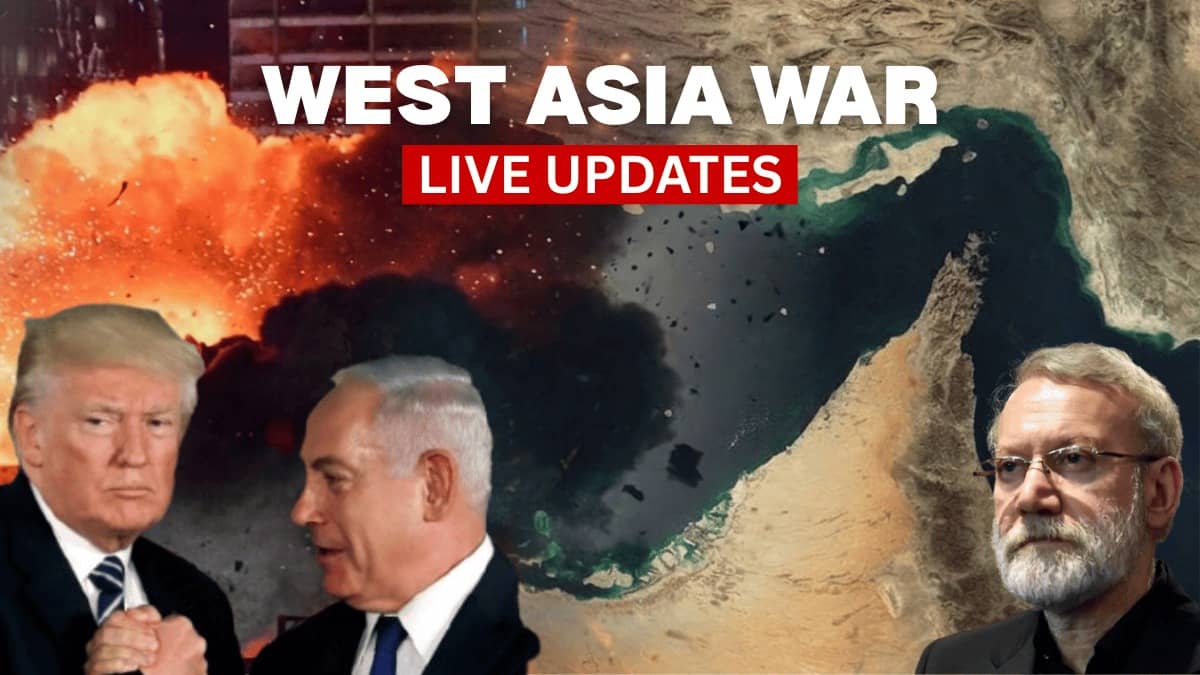
b>great test His response to a resounding lack of support for securing the Strait of Hormuz is underscoring the fine line that US-allied countries, including Australia, are treading as the war in the Middle East continues for a third week.
Overnight, Trump lashed out at Australia, Japan, South Korea and the NATO alliance, saying in a Truth Social post the US no longer wanted or needed their assistance.
However, the Australian government said that a formal request hadn't been made for support in the key oil shipping channel.
Trump said the US had been told by "most" of its NATO allies that they "don't want to get involved" in the conflict despite supporting it.
But was the request a "fantasy" in the first place, and what could happen if Trump continues to be rebuffed by the US' allies? Earlier this week, Trump called on partners to send ships to the Strait of Hormuz, through which about 20 per cent of the world's oil and gas is shipped.
Iran has effectively blocked the channel since the US and Israel attacked last month — sending global oil prices skyrocketing.
"Hopefully China, France, Japan, South Korea, the UK, and others, that are affected by this artificial constraint will send ships to the area so that the Hormuz Strait will no longer be a threat by a nation that has been totally decapitated," Trump's 14 March social post read.
Some naval analysts have said sending vessels to protect shipping traffic in the strait would carry significant risks, and would likely restore only a fraction of pre-war traffic.
Trump's suggestion failed to gain support, with several European leaders outright rejecting it.
A spokesperson for German Chancellor Friedrich Merz said "this war has nothing to do with NATO", describing it as a defensive alliance.
UK Prime Minister Keir Starmer said his country "will not be drawn into the wider war", though its energy minister, Ed Milliband, said the UK was considering ways it could contribute to get the strait reopened.
French President Emmanuel Macron said France would not consider operations in the strait until the situation had de-escalated.
Speaking to reporters, Trump accused NATO of making a "very foolish mistake".
"I've long said that I wonder whether or not NATO would ever be there for us.
So this was a great test," he said.
Brendon O'Connor, a professor of US politics and US foreign relations at the University of Sydney, told SBS News few countries have the naval capacity to secure large numbers of tankers in the strait.
"This isn't something the US is very capable of doing itself — the largest military in the world — [so] to believe that the Japanese or the Australians have that capacity, or the British, even, isn't realistic." "This is fantasy from Trump, to some extent," he said.
Trump's increasingly unilateral approach in his second term has made traditional security partners more reluctant to support US military ventures, said international conflict expert Jessica Genauer, academic director of the Public Policy Institute at the University of New South Wales.
Allies and middle powers don't want to be associated with these kind of military actions, she told SBS News, adding that involvement is also unpopular with many domestic audiences.
Australia, she said, is navigating a delicate balancing act — steering clear of appearing "all in" on a US military operation in Iran, while avoiding....