No keynote this time.
No stage at Apple Park, no Tim Cook introduction into a darkened theatre, no orchestral swell as the screen resolves to a product shot.
A staggered sequence of press releases over three days instead, a cryptic MacBook silhouette on Tim Cook's social media feed, and a media event in three cities simultaneously — New York, London, Shanghai, 9:00am Eastern Time, Wednesday March 4.
The invitation is a three-dimensional Apple logo assembled from yellow, green, and blue discs.
The discs are a colour signal about the budget MacBook arriving Wednesday.
Apple does not do accidents.
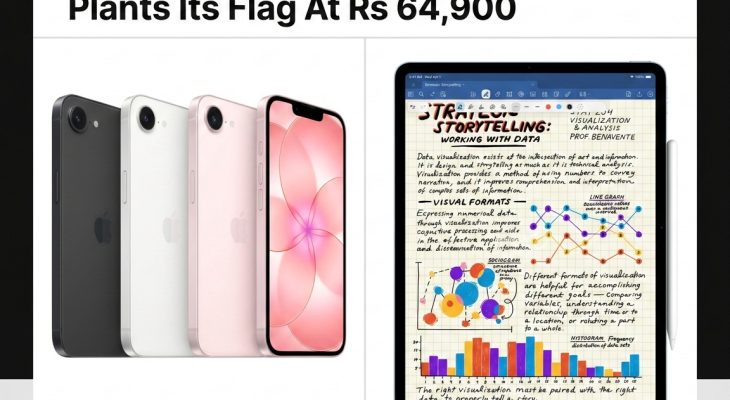
Two products on Monday.
Both Rs 64,900.
Both Rs 5,000 more expensive than their predecessors, which launched exactly one year ago at Rs 59,900 each.
That convergence — identical price, identical increase, identical date — is calculated, not coincidental.
And the reason for it is considerably more interesting than either device.
RAMmageddon — The Memory Crisis Behind Both Price Tags Start here, because everything else flows from it.
The global DRAM and NAND flash memory market is in structural crisis.
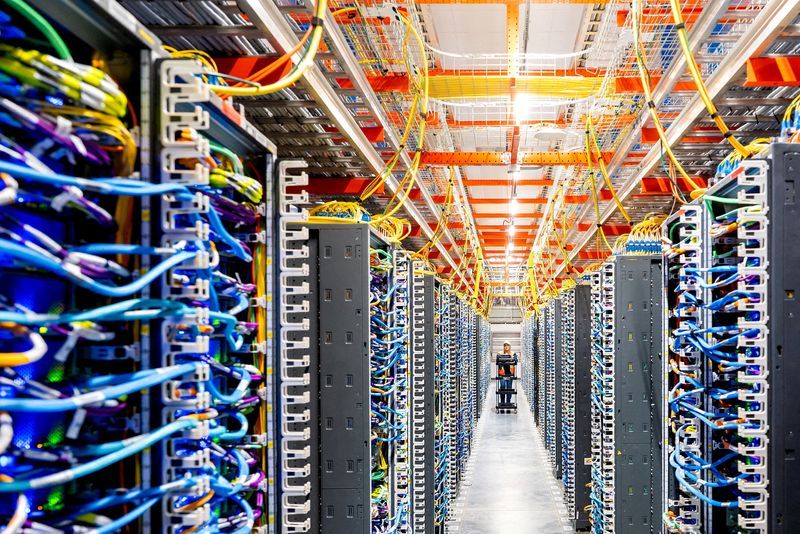
Samsung Electronics, SK Hynix, and Micron — the three manufacturers who between them produce the world's supply of mobile memory — have been systematically redirecting production capacity away from consumer LPDDR5X chips toward high-bandwidth memory for AI data centres.
Every wafer allocated to an HBM stack destined for an Nvidia GPU is, as IDC stated plainly in its February 2026 analysis, "a wafer denied to the LPDDR5X module of a mid-range smartphone or the SSD of a consumer laptop." This is zero-sum.
The smartphone market is currently losing.
The consequences reached Apple's procurement desk with unusual directness.
According to Korean financial outlet DealSite — reported and confirmed by AppleInsider and MacRumors in late February 2026 — Samsung approached Apple with a plan to raise LPDDR5X memory prices by 60 per cent for iPhone production in the first half of 2026.
At the first negotiation, Samsung proposed 100 per cent instead.
Apple immediately accepted.
A semiconductor industry insider quoted in the DealSite report described it with stark economy: "Initially, Samsung set a strategy with the goal of increasing the price of LPDDR5X for Apple iPhone by about 60 per cent.
However, at the first negotiation table, they first proposed a 100 per cent increase, and Apple immediately accepted it." Apple did not negotiate.
The company that typically extracts supplier concessions on the leverage of 250 million annual unit volumes simply said yes.
The numbers explain the capitulation.
A 12GB LPDDR5X module climbed from roughly $25 in early 2025 to approximately $70 by the time this deal was struck, per Dataconomy.
TrendForce projected conventional DRAM contract prices rising 90 to 95 per cent in the first quarter of 2026 alone.
The wholesale cost of RAM to manufacturers is predicted to reach three to four times early-2025 levels by year end — meaning Apple may have actually secured the better end of a deal it appeared to lose.
SK Hynix disclosed in February that its DRAM and NAND inventories sat at approximately four weeks of supply, and its entire HBM capacity for 2026 sold out months prior.
IDC projected a record 13 per cent decline for the global smartphone market in 2026, driven almost entirely by memory economics.
Apple reportedly pays double its previous rate for NAND storage as well.
It reportedly pays double for the A20 processor — arriving in the iPhone 18 Pro in September — compared to what it paid for the A19.
Tim Cook, pressed on these shortages during Apple's January 2026 earnings call, described the memory situation as having "minimal impact" on the December quarter while acknowledging pressure ahead.
The Rs 5,000 price increase on both the iPhone 17e and the iPad Air M4 is, against those figures, remarkable restraint.
Apple absorbed the bulk of a cost it is paying double for, and passed Rs 5,000 — approximately $60 — to the consumer.
It also doubled the iPhone 17e's base storage from 128GB to 256GB simultaneously, converting the increase into a value argument rather than a margin confession.
That is either extraordinary financial discipline or the most elegant pricing communication in recent consumer electronics history.
It is probably both.
The iPhone 16e Proof — Why The 17e Matters Before addressing what the iPhone 17e is, address what its predecessor proved.
The iPhone 16e launched in February 2025 at Rs 59,900 in India and was greeted by a technology press that spent three weeks explaining, with considerable confidence, why rational humans would choose otherwise.
It proceeded to ignore that advice entirely.
In its first full quarter of availability, it captured 11 per cent of all US iPhone sales, per CIRP data.
The iPhone SE it replaced managed 5 per cent in the same quarter the prior year.
Apple's affordable tier instantly doubled its US contribution.
Legacy iPhone 14 and 15 models, which held 28 per cent of US iPhone sales, fell to 15 per cent as the 16e absorbed their upgrade demand.
India delivered the clearest verdict.
The iPhone 16 base model — at approximately Rs 71,000, a tier above the 16e — became the single best-selling smartphone in India for the full year 2025, capturing roughly 4 per cent of the country's entire 154-million-unit market, or approximately 6.16 million units, per Counterpoint Research data.
Apple achieved a record 9 per cent share of India's smartphone market by volume in 2025, up from 7 per cent in 2024.
By value, it reached 28 per cent — making it India's largest smartphone player by revenue, ahead of Samsung and every Chinese brand.
Apple India shipments grew 21.5 per cent year-on-year to 5.9 million units in the first half of 2025 alone, per IDC.
The 16e had specific, nameable gaps.
It lacked MagSafe.
No ultrawide camera.
The $599 US price sat awkwardly above the SE's $429 legacy.
The 17e corrects all three.
Adds MagSafe.
Doubles base storage to 256GB at the same price tier.
And — the part that should genuinely alarm every Android OEM operating between Rs 50,000 and Rs 85,000 — replaces the A18 with the A19.
The same chip inside the Pro Max.
A19 On An Entry iPhone — The Decision That Changes Everything The most consequential design choice Apple made for the iPhone 17e was refusing to tier down on silicon.
The A19 is built on a 3-nanometer process with a 6-core CPU, a 4-core GPU carrying hardware-accelerated ray tracing, and a 16-core Neural Engine.
It runs in the iPhone 17, 17 Plus, 17 Pro, and 17 Pro Max without qualification.
The 17e carries it with identical claim.
This is not a cost-reduced variant.
This is the chip.
What this means for Apple Intelligence is specific.
Call Screening in Indian English, Hold Assist, Visual Intelligence, Writing Tools — every on-device AI feature runs identically on the 17e and the Pro Max.
Every capability available on the most expensive iPhone in the lineup is available at Rs 64,900.
No asterisks.
That argument matters more in India than almost anywhere else.
Spam calls are not a minor inconvenience in this market — they are a daily siege.
Call Screening, which automatically queries unknown callers and filters them before the phone rings, delivers measurable quality-of-life impact.
Hold Assist, which maintains a position in a phone queue and alerts the user when a human operator arrives, is a small act of consumer advocacy in a market accustomed to 45-minute hold times with telecom and insurance operators.
Both features support Indian English.
Both require the Neural Engine that now ships at Rs 64,900.
The C1X modem sharpens the silicon argument further.
Apple's second-generation in-house cellular chip doubles the download performance of the C1 in the iPhone 16e and draws 30 per cent less energy than the modem inside the iPhone 16 Pro.
In a country where 4G and 5G are primary internet access rather than backup connectivity, modem efficiency converts directly into battery life across a working day.
Apple will market the camera.
Users will discover the C1X within 72 hours.
What The 17e Trades Away Kaiann Drance, Apple's VP of Worldwide iPhone Product Marketing, called the 17e "a compelling option for customers looking to upgrade to the iPhone 17 family" that "delivers just that" for customers who want a lasting product.
The hardware claims in that statement are accurate.
The full picture requires additions.
The 17e retains the notch.
Dynamic Island — Apple's pill-shaped cutout that functions as a live display element, present on every other 2025 iPhone — is absent.
The display runs at 60 frames per second.
Against the Vivo X300 Pro, Pixel 10 Pro, Xiaomi 17 Ultra, and Galaxy S26 Ultra — all offering 120Hz adaptive refresh at comparable or higher prices — the 17e's panel feels deliberately stationary.
There is no always-on display.
There is no ultrawide camera.
Just the single 48MP Fusion lens with its sensor-crop 2x zoom.
The camera story is genuinely good for a single-lens system.
Against an Android competitor at Rs 84,999 offering a Zeiss quad-camera array with a dedicated 50MP selfie lens, the comparison requires candour.
These trade-offs exist because the Rs 64,900 price point exists against a memory cost structure that just doubled.
They are engineering decisions, not oversights.
A buyer upgrading from an iPhone 11 will find the 17e transformative.
A buyer moving from a Pixel 9a will find specific, identifiable gaps.
Both things are true simultaneously.
The Camera: 2 Focal Lengths, 1 Lens The 48MP Fusion camera achieves something that sounds implausible until the physics are understood.
A full 48MP capture uses the entire sensor.
A 12MP crop of the central portion corresponds to a 2x optical zoom with zero interpolation penalty — the sensor is large enough that the cropped portion retains full 12MP integrity.
Two focal lengths, one element: 24mm-equivalent wide and 48mm-equivalent short telephoto.
Apple calls this optical-quality, and the engineering holds.
It is a sensor crop, not a dedicated telephoto lens.
The distinction matters when comparing against Android rivals at comparable prices with actual periscope zoom systems.
Portrait mode earns a genuine upgrade.
The A19's improved computational pipeline recognises people, dogs, and cats in frame and saves depth information at capture even when Portrait mode was never selected.
Open any photo in the Photos app later, apply background blur retroactively, shift focus between subjects after the fact.
For Indian family photography — where the decision to portrait-ise an image almost always arrives after the moment, once the composition has been evaluated in peace rather than in a birthday-party scrum — this transforms the shooting workflow in a way that is immediately and repeatedly useful.
Video records at 4K Dolby Vision up to 60 frames per second with Spatial Audio, Audio Mix, and continuous machine learning-based wind noise reduction.
The Action button provides one-press access to Visual Intelligence, the flashlight, or any assigned shortcut.
These are the standard iPhone 17 specifications, running without modification.
MagSafe At Rs 64,900 — The Ecosystem Opens MagSafe on the 17e is more consequential than the 15W charging speed, though that figure — double the 7.5W Qi of the iPhone 16e — is meaningful in itself.
The magnetic alignment system opens the entire MagSafe accessory ecosystem to a tier where it was previously locked out.
Snap-on wallets, car mounts that align with one hand, photography grips, multi-device charging pads — hundreds of third-party accessories now compatible with India's entry-level iPhone.
Ceramic Shield 2 front glass delivers 3x better scratch resistance over the previous generation, measurable rather than claimed, with improved anti-reflection for outdoor readability.
IP68 water resistance to 6 metres for 30 minutes.
Satellite features — Emergency SOS, Roadside Assistance, Messages, Find My — free for two years post-activation.
The device....