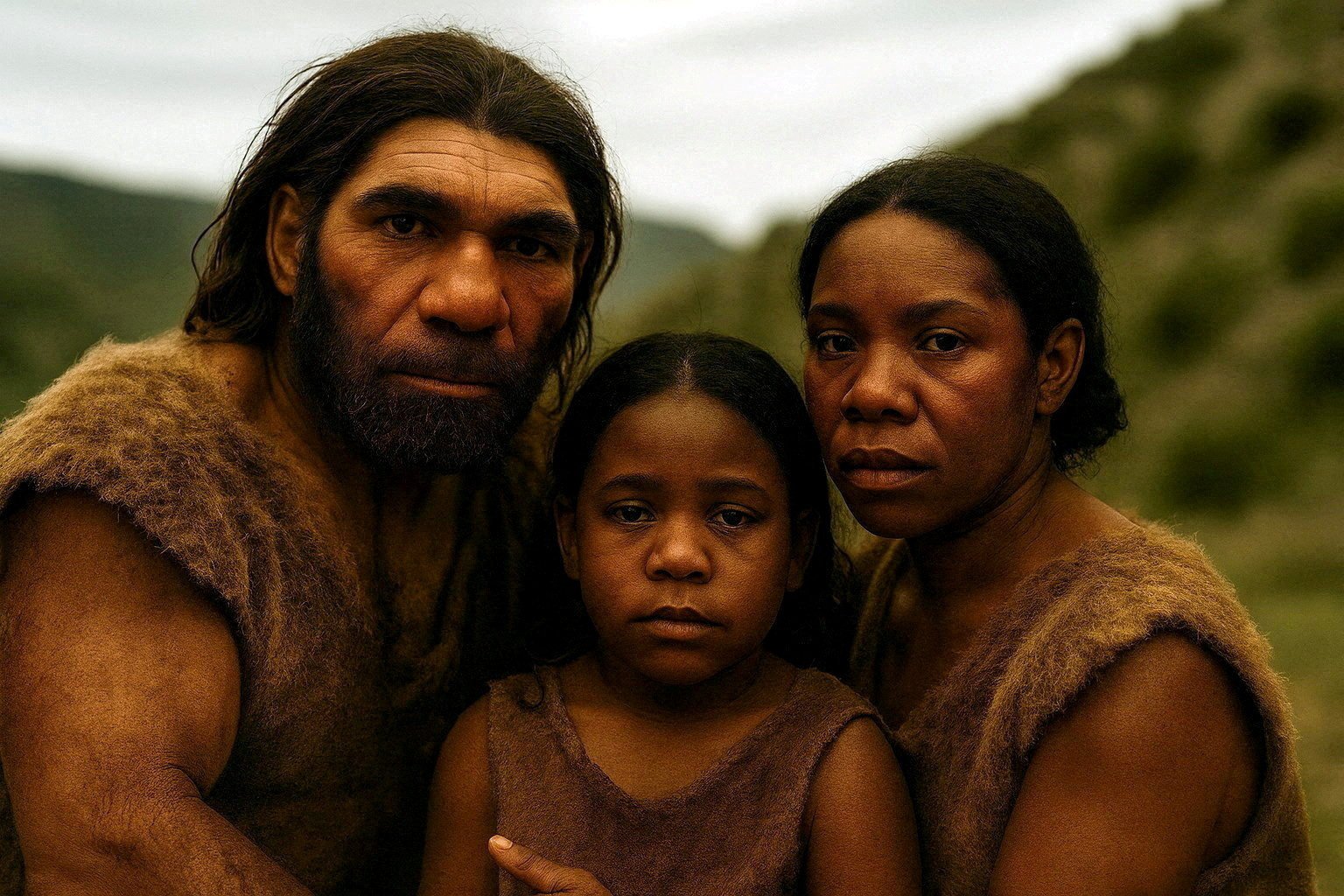
When Homo sapiens trekked out of Africa, they encountered Neanderthal populations already inhabiting the vast expanses of Europe, Asia and the Middle East.
As the presence of Neanderthal DNA in most present-day people shows, interbreeding occurred, though the circumstances have remained unclear.
New research focusing on the X chromosome, one of the two sex chromosomes, in present-day people and, as revealed by ancient genomes, in Neanderthals, is providing insight into who took part in these prehistoric pairings.
The genetic analysis backs the conclusion that this phenomenon was primarily driven by sex between Neanderthal men and Homo sapiens women.
The researchers said it is unknown why this occurred – whether by peaceful mating preference, by force or some other scenario.
“The preferences of either or both parties could produce these kinds of patterns, with or without the consent of the other,” says geneticist Alexander Platt, of the University of Pennsylvania’s Perelman School of Medicine in the US, who was co-lead author of the research published last week in the journal Science.
Chromosomes are thread-like structures that carry genetic information from cell to cell.
In people, females carry two X chromosomes – one inherited from each parent.
Males carry one X chromosome inherited from their mother and one Y chromosome from their father.
For the other chromosomes, everyone has two copies – one from each parent, equally distributed across the sexes.
Most people, with the exception of certain sub-Saharan African populations, carry small amounts – often 1 to 4 per cent – of Neanderthal DNA across much of their genome but have little to none on their X chromosomes.
Africans are the exception because their ancestors, having stayed on the continent, never mixed with Neanderthals.
The genomes of three Neanderthals showed an excess of Homo sapiens DNA on X chromosomes, a pattern opposite to that of present-day people and suggestive of male Neanderthals and female Homo sapiens mating.
The researchers also examined genetic data from present-day Africans lacking Neanderthal ancestry to better track gene flow between Homo sapiens and Neanderthals who interbred starting as early as 250,000 years....


/afaqs/media/media_files/2025/05/07/oOMY4jR3x4g8NZqQIFlp.jpg)